Pai Gow Poker and the Strategy of Splitting Seven Cards
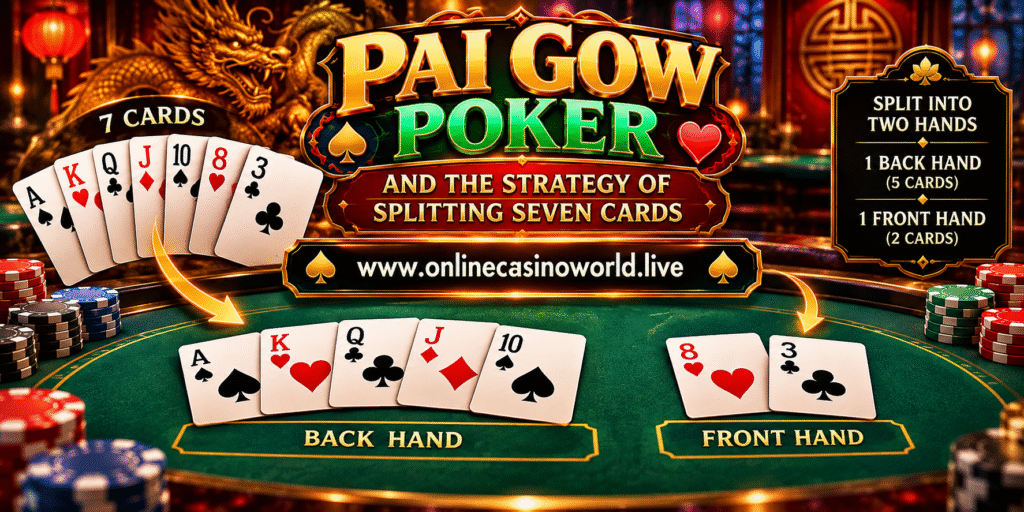
Pai Gow Poker is a distinctive casino card game that combines traditional poker rankings with an unusual challenge: arranging seven cards into two separate hands. Unlike conventional poker games, where players generally focus on building one winning combination, Pai Gow Poker requires players to balance a five-card hand against a two-card hand. Both hands matter, and the way the cards are divided can influence the final outcome.
For beginners, understanding this splitting process is the most important step toward learning the game. A strong five-card hand does not always produce the best overall arrangement if the remaining two cards are weak. The objective is to create two competitive hands while following the game’s essential rules.
This guide for OnlineCasinoWorld.live explains how Pai Gow Poker works, how to divide seven cards, which combinations require extra attention, and why understanding the rules matters before making any betting decisions.
What Is Pai Gow Poker?
Pai Gow Poker is a casino card game in which players compete against the dealer or designated banker rather than against one another. A standard version uses a 53-card deck consisting of 52 regular playing cards and one joker.
Each player receives seven cards and must arrange them into two hands. The first contains five cards and is commonly called the high hand, back hand, or big hand. The second contains two cards and is known as the low hand, front hand, or small hand.
The five-card hand follows conventional poker rankings, while the two-card hand can contain a pair or a combination of unmatched cards. A pair outranks any unpaired two-card combination.
The goal is to beat the banker’s corresponding hands. Winning both comparisons generally wins the main wager, while losing both normally loses it. Winning one hand and losing the other usually produces a push, meaning the main wager is returned under standard rules.
The Golden Rule of Splitting Seven Cards
The most important rule in Pai Gow Poker is that the five-card high hand must rank higher than the two-card low hand. Players cannot simply place their strongest combination in either position without considering the relationship between the two hands.
For example, imagine receiving a pair of kings and several unrelated cards. Keeping the kings in the five-card hand may create a strong high hand, while the remaining two highest cards can form the low hand. This arrangement follows the basic principle because the pair of kings outranks the unpaired low hand.
However, if the two-card hand contains a pair of aces, the five-card hand must be stronger than that pair. Placing a weaker pair in the high hand would create an invalid arrangement.
An arrangement that violates the required ranking is commonly called a foul hand. Depending on the table rules, a foul hand may automatically lose the main wager. Beginners should therefore check both hands before confirming their final arrangement.
Understanding the Five-Card High Hand
The high hand uses standard five-card poker combinations. From strongest to weakest, the usual rankings are royal flush, straight flush, four of a kind, full house, flush, straight, three of a kind, two pair, one pair, and high card.
A royal flush contains ten, jack, queen, king, and ace of the same suit. Four of a kind contains four cards of the same rank, while a full house combines three cards of one rank with a pair of another.
These rankings help determine whether the five-card hand can defeat the banker’s high hand. A straight beats three of a kind in some nonstandard games only if their rules specify it, but under conventional poker rankings, three of a kind outranks a straight. Learning the proper order prevents confusion when comparing hands.
Some Pai Gow Poker versions also use special rules for the joker and certain straights. The posted table rules should always take priority over general assumptions.
Understanding the Two-Card Low Hand
The low hand is simpler because only pairs and high-card combinations are possible. Straights and flushes do not apply to a two-card hand.
Any pair beats an unpaired combination. Among pairs, the higher-ranked pair wins. For example, a pair of queens beats a pair of sevens.
When neither hand contains a pair, the highest card determines the initial comparison. If both highest cards match, the second card breaks the tie. An ace and king form a stronger unpaired combination than an ace and ten.
This ranking makes the low hand important even when the five-card hand looks impressive. If the low hand is too weak, a player may lose that comparison even after winning the high hand.
How to Balance Both Hands
A useful starting principle is to avoid concentrating all the strength in one hand when doing so leaves the other unnecessarily weak. Instead, consider how the seven cards can be divided to create two competitive combinations.
Suppose a player receives an ace, king, queen, nine, seven, four, and two, with no pair or useful straight or flush combination. The player must choose which cards remain in the five-card hand and which two form the low hand.
Keeping the ace in the high hand while placing the king and queen in the low hand may produce a stronger front combination, but the complete five-card hand must still be evaluated. The correct arrangement depends on the rankings created by the available cards and the applicable house rules.
The best split is not always the one that produces the strongest possible five-card hand. The real objective is to maximize the chances of winning both comparisons without creating an invalid arrangement.
Splitting One Pair
A single pair is one of the more straightforward starting points. In many common arrangements, players keep the pair in the five-card high hand and use their strongest remaining cards to form the two-card low hand.
For example, consider a hand containing two queens, an ace, a king, a seven, a five, and a three. Keeping the queens together in the high hand preserves a pair, while the ace and king can form the low hand.
This division gives both hands a clear purpose. The high hand has a pair, and the low hand has two strong unmatched cards.
Nevertheless, no split guarantees a win. The dealer may have stronger combinations in either position, and the final result depends on both comparisons.
The Challenge of Two Pair
Two-pair hands can create more complicated decisions because the player must choose whether to keep both pairs together or divide them between the two hands.
Keeping both pairs in the high hand can produce a powerful five-card combination, especially when the remaining cards are weak. Splitting the pairs may improve the low hand by placing one pair in front, but it also reduces the strength of the high hand.
The appropriate choice depends on the ranks of the pairs, the remaining cards, and the rules used by the casino. Some standard house-way charts recommend splitting two pair in many situations, while other holdings are better kept together.
Beginners should avoid treating one rule as universal. When uncertain, consult the game’s published hand-setting guide or an approved house-way reference.
Handling Three of a Kind and Full Houses
Three of a kind gives a player three cards of the same rank. Keeping all three cards together can create a strong high hand, while the remaining two cards form the low hand. However, certain holdings may allow other arrangements worth considering.
A full house contains three cards of one rank and a separate pair. Players often face the decision of whether to keep the full house together in the high hand or separate the pair into the low hand.
Splitting a full house can strengthen the low hand because it creates a pair, but the high hand loses some of its original strength. Whether that trade-off is worthwhile depends on the specific cards and the applicable strategy rules.
Because these decisions can be less intuitive, beginners should learn the standard house way for the version they are playing rather than relying only on general advice.
The Role of the Joker
Many standard Pai Gow Poker games include one joker, but it is not always a completely wild card. Its permitted uses are generally restricted.
In common versions, the joker can act as an ace or complete a straight, flush, straight flush, or royal flush when the appropriate conditions are met. Exact treatment can vary by game.
The joker can therefore change the best way to divide seven cards. A hand that initially appears ordinary may become a much stronger five-card combination when the joker completes a qualifying sequence or flush.
Players should check the rules before assuming that the joker can represent any card in every situation. Understanding its restrictions helps avoid incorrect hand rankings and poor splitting decisions.
What Is the House Way?
The house way is the procedure a casino uses to arrange the dealer’s seven cards into the required high and low hands. It provides a consistent method for setting the banker’s hand.
Players may use a similar guide to understand common hand-setting principles. However, a casino’s house way is not necessarily identical to every published strategy chart, and the details can vary between versions.
A house-way guide is especially useful for beginners dealing with two pair, full houses, four of a kind, and joker combinations. These hands may have several legal arrangements, and choosing between them requires considering the strength of both resulting hands.
Learning the house way can reduce avoidable mistakes, but it does not remove the game’s built-in house advantage.
How Winning, Losing, and Pushes Work
After the player sets the two hands, the dealer arranges the banker’s cards according to the applicable rules. The corresponding five-card hands are compared, followed by the two-card hands.
If the player wins both comparisons, the main wager generally wins. If the dealer wins both, the player normally loses the wager. If each side wins one comparison, the result is usually a push.
Ties also require attention. In many versions, the banker wins tied individual hands, although exact rules should be confirmed before playing.
Some casinos deduct a commission from winning wagers, while others offer different settlement arrangements. These details influence the amount returned after a successful round, so the payout rules should be reviewed beforehand.
Final Thoughts
Pai Gow Poker stands apart from many casino card games because its central challenge is arranging seven cards into two hands that work together. The five-card high hand must outrank the two-card low hand, and both are compared with the banker’s corresponding hands.
Understanding poker rankings, balancing the two hands, handling pairs, and learning the joker rules can make the game easier to follow. The house way also provides a useful starting point for understanding difficult arrangements, although its exact instructions may vary between casinos.
For OnlineCasinoWorld.live readers, the key lesson is to evaluate all seven cards before making a final split. A strong arrangement considers both hands rather than sacrificing one unnecessarily. Pai Gow Poker remains a game of chance, and careful hand setting cannot guarantee profit. Anyone considering real-money play should follow local laws, meet the applicable age requirements, establish firm limits, and treat gambling as entertainment rather than a source of income.