Craps Table Layout Explained With Pass Line and Proposition Bets

Craps can look complicated at first because a single table contains numerous betting areas, numbers, and payout instructions. However, the game uses only two dice, and its layout becomes easier to understand when each section is learned separately. Some wagers follow the Pass Line and depend on a point being repeated before a seven appears. Others, called proposition bets, focus on particular results from the next roll.
For readers of OnlineCasinoWorld.live, this guide explains how to read a standard craps table, how the Pass Line works, and what common proposition bets mean. Table designs and payouts can vary, so players should always check the rules displayed at their chosen table.
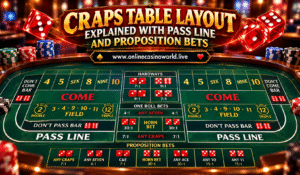
Understanding the Craps Table Layout
A traditional craps table has two mirrored player sections and a shared centre area. The duplicated ends allow players standing in different positions to access similar betting options. However, everyone participates in the same dice game, meaning one roll can settle wagers across the entire table.
The outer edge contains the Pass Line, one of the main starting points for beginners. Nearby, the Don’t Pass section offers an opposing wager. Other areas include Come, Don’t Come, Field, numbered boxes for Place bets, and spaces for additional odds wagers.
The centre section usually contains proposition bets and hardway wagers. These areas may display numerous combinations and payout labels, making the layout appear more complicated than it really is.
New players do not need to memorize every section immediately. Start with the Pass Line, understand the sequence of a round, and gradually learn the other betting areas.
What Is the Pass Line Bet?
The Pass Line is a basic wager placed before the shooter’s first roll, known as the come-out roll. The result determines whether the wager wins immediately, loses immediately, or continues into another phase.
If the dice total seven or eleven, the Pass Line wins. If they total two, three, or twelve, the wager loses under standard rules. Any other total establishes the point: four, five, six, eight, nine, or ten.
Once the point is established, the dealer usually places a marker called the puck on the corresponding number and turns it to the ON side. The shooter continues rolling until either the point repeats or a seven appears.
If the point appears first, the Pass Line wins. If seven appears first, the wager loses. Other totals generally leave the point active.
For example, suppose the come-out roll totals six. Six becomes the point. A later roll of six wins the Pass Line, but a seven appearing before that repeat causes the wager to lose.
The Pass Line is generally a contract bet after the point is established, meaning it cannot simply be removed before the result is decided.
Understanding the Don’t Pass Area
The Don’t Pass wager generally takes the opposite side of the Pass Line. On the come-out roll, it usually wins on two or three, loses on seven or eleven, and pushes on twelve. A push means the original wager is returned without a win or loss.
Some tables use different rules for the push number, so players should read the printed instructions.
Once a point is established, Don’t Pass wins if seven appears before the point repeats. If the point appears first, the wager loses.
Although these bets generally oppose one another, their come-out rules are not exact opposites because of the push condition. Both are standard craps wagers, and neither predicts the shooter’s skill or guarantees a particular outcome.
What Are Proposition Bets?
Proposition bets occupy the centre of many craps tables. They usually predict a specific dice total, a particular combination, or a special way a number appears. Unlike the Pass Line, many proposition bets settle on the next roll.
Common examples include Any Seven, Any Craps, individual totals, Horn bets, and hardways.
These wagers often display larger payouts than basic line bets. However, a larger advertised return does not necessarily indicate better value. Less frequent outcomes generally attract higher payouts, and the house edge depends on both the probability of winning and the payment offered.
Before placing a proposition bet, identify the required result, determine whether the wager applies to the next roll only, and check its payout schedule.
Any Seven and Any Craps
An Any Seven bet predicts that the next roll will total seven. With two standard dice, six of the 36 equally likely combinations produce this total. A common payout is four to one, although individual table rules may differ.
An Any Craps bet typically covers totals of two, three, or twelve on the next roll. Two can occur in one combination, three in two combinations, and twelve in one combination. These four outcomes together represent four of the 36 equally likely combinations.
A common Any Craps payout is seven to one. Despite being easy to understand, the wager can lose immediately when the dice produce any other total.
These bets illustrate why payout figures should be considered alongside probability. The result is decided quickly, and repeated losses can accumulate if players continue wagering without limits.
Horn Bets and Individual Totals
A Horn bet combines wagers on two, three, eleven, and twelve. The total stake is divided among those outcomes according to the table’s procedure. Since the totals have different probabilities and payout terms, a Horn bet is more complex than selecting one number.
Some tables also offer individual bets on totals such as two, three, eleven, or twelve. These are generally settled on the next roll, and the payout depends on the selected total and the casino’s rules.
Players should distinguish between the winnings and the total return. A payout expressed as winnings relative to the stake is different from a figure that includes the original wager.
If the payout information is unclear, ask the dealer or review the online game’s instructions before placing chips.
Hardway Bets Explained
Hardway bets predict that four, six, eight, or ten will appear as a pair of matching dice.
For example, a hard eight means four plus four. A regular eight can also be made through combinations such as two plus six or three plus five. Those combinations are not hard eights because the dice show different numbers.
A hardway wager generally wins when the selected total appears in matching form before a seven or before that total appears in a nonmatching combination. The exact conditions depend on the game’s rules.
Consider a hard six. Three plus three produces a hard six, while one plus five and two plus four produce easy sixes. Under standard rules, an easy six or a seven appearing first defeats the hardway wager.
Hardways therefore differ from ordinary total bets because the way the dice produce the number matters.
How the Field Bet Works
The Field is usually a one-roll wager covering a specified group of totals. A common version wins on two, three, four, nine, ten, eleven, or twelve and loses on five, six, seven, or eight.
Some tables offer enhanced payments for two or twelve, while others use different schedules. Players should inspect the printed payout information rather than assuming that every Field bet follows identical rules.
The Field is separate from the Pass Line and is normally settled on the next roll, regardless of whether a point is active.
Because it covers several possible totals, the wager may appear straightforward. Nevertheless, its value depends on the precise outcomes covered and the payout schedule.
Reading the Puck and Placing Chips
The puck indicates whether the game is in the come-out phase or following an established point. When the marker is OFF, the next roll begins a new Pass Line cycle. When it is ON, the point is active.
Watching the marker helps explain why a seven can win during one phase but lose a Pass Line wager during another.
At physical tables, dealers may position certain wagers, including Place bets, odds bets, and proposition bets. Players should communicate their intentions clearly and follow the casino’s procedures. Online interfaces generally display labelled betting areas, but the same rules apply.
Never assume that chips placed near a printed section automatically count as a wager. Confirm that the bet has been accepted before the dice roll.
Payouts, Probability, and Common Mistakes
A payout describes what a winning wager returns, while probability describes how frequently an outcome can occur. The house edge represents the casino’s theoretical advantage over many wagers.
Proposition bets often offer higher payouts because their winning conditions are more specific. However, the advertised return alone does not establish whether a wager has favourable mathematical value.
A common beginner mistake is assuming that seven always wins or always loses. Its effect depends on the stage of the game and the wager being considered. Another mistake is confusing a one-roll proposition bet with a Pass Line wager that may remain active across several rolls.
Players should also avoid assuming that a number is due after being absent for several rounds. Each fair dice roll is independent, and previous results do not guarantee the next outcome.
Final Thoughts
The craps table becomes easier to understand when divided into its main sections. The Pass Line follows the come-out roll and point cycle, while Don’t Pass offers an opposing wager. The Field and centre proposition areas provide other ways to predict dice results, and hardways require a particular combination of matching dice.
Beginners can start by learning the Pass Line, recognizing when a point becomes active, and observing how the puck changes the meaning of later rolls. Proposition bets can be explored after their winning conditions and payouts are understood.
Craps remains a game of chance, and no betting system guarantees a profit. Only adults legally permitted to gamble should participate. Establish a clear entertainment budget, avoid chasing losses, and stop if gambling becomes stressful or affects essential expenses. Understanding the layout can make the game easier to follow, but it cannot eliminate the financial risks.