RTP in Casino Games: What Does It Mean?
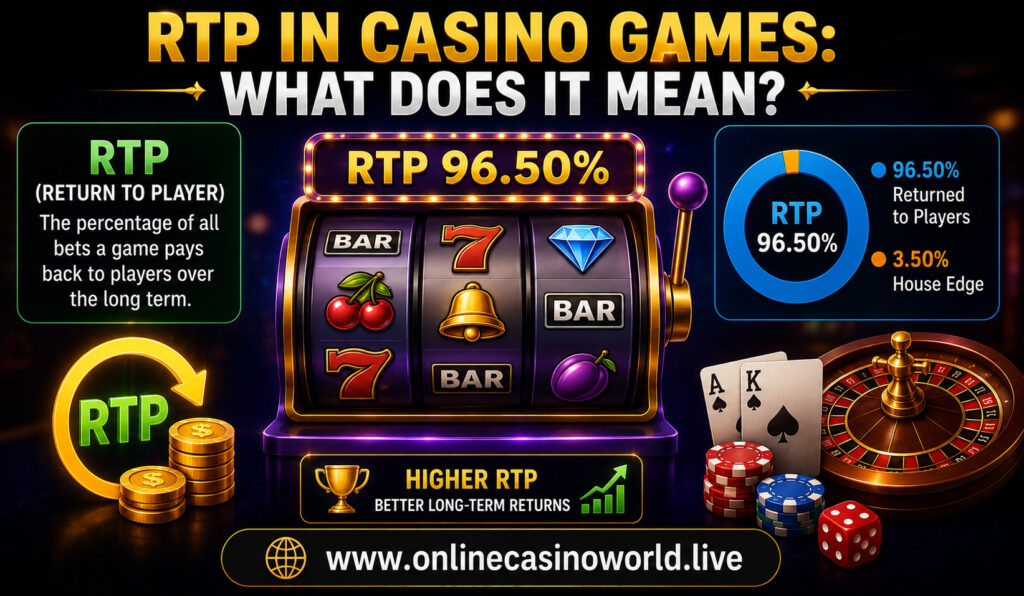
RTP is one of the most important terms to understand when learning how casino games work. You may see RTP, or Return to Player, mentioned in information about slot machines, table games, and other gambling products. Although the concept sounds technical, the basic idea is fairly simple.
RTP is a theoretical percentage that describes how much a game is designed to return to players over a very large number of plays. It does not predict what will happen during one gaming session, and it certainly does not guarantee that a player will receive a specific amount back.
For beginners, understanding RTP can make casino game information easier to interpret. It also helps explain how RTP differs from house edge, volatility, probability, and actual short-term results.
What Does RTP Stand For?
RTP stands for Return to Player.
It is normally expressed as a percentage.
For example, suppose a game has a theoretical RTP of 96%. Over an extremely large number of plays, the mathematical model is designed to return approximately ₹96 for every ₹100 wagered.
The remaining theoretical amount represents the house advantage.
However, this does not mean that a person who wagers ₹100 will receive ₹96 back.
The actual result of a short session can be very different because individual outcomes are affected by randomness.
How RTP Works
RTP is based on long-term mathematical expectations.
Imagine a hypothetical game with an RTP of 95%.
If players collectively make a very large amount of wagers over a sufficiently large sample, the game’s theoretical return would approach approximately 95% of the total amount wagered.
If ₹10 crore were wagered over a huge number of plays, the theoretical return would be around ₹9.5 crore.
This is a mathematical model rather than a promise.
Individual players can experience results far above or below the theoretical RTP.
RTP Is Not a Guarantee
This is perhaps the most important point for beginners.
An RTP of 96% does not mean:
“For every ₹100 I spend, I will get ₹96 back.”
It means that, under the game’s mathematical model, the expected return approaches that percentage over a sufficiently large number of plays.
Short-term outcomes can vary dramatically.
A player could win more than the theoretical return during one session, or lose substantially more.
Randomness creates this variation.
RTP vs House Edge
RTP and house edge are closely related, but they describe the mathematics from different perspectives.
RTP describes the theoretical percentage returned to players.
House edge describes the theoretical percentage retained by the casino or operator.
For a simple example:
RTP = 96%
House edge = 4%
Together, they represent the game’s theoretical mathematical distribution.
However, actual calculations can be more complicated for games with multiple bet types, side bets, progressive jackpots, or special rules.
Why RTP Is Important
RTP can be useful when comparing games from a mathematical perspective.
Suppose two games have otherwise comparable structures but different theoretical RTP figures.
A higher RTP generally means a lower theoretical house advantage, assuming the figures are calculated on the same basis.
However, RTP should not be considered by itself.
Other characteristics, such as volatility, game rules, payout structures, and available features, can also affect how a game behaves.
RTP in Slot Machines
RTP is especially common in discussions about slot machines.
A slot game might advertise a theoretical RTP such as 94%, 96%, or another percentage.
The figure represents the game’s expected long-term return according to its mathematical design.
Different slot games can have different RTP values.
Some games may even offer multiple RTP settings depending on the version, operator, or configuration.
Therefore, it is important to check the specific game’s published information rather than assuming every slot has the same RTP.
RTP in Table Games
RTP can also be discussed in relation to table games.
However, calculating RTP for games such as blackjack can be more complicated because the result depends on the exact rules and player decisions.
Factors can include:
- Number of decks
- Dealer rules
- Blackjack payout
- Doubling rules
- Splitting rules
- Surrender availability
- Player decisions
This means that there may not be one universal RTP figure for every version of a particular table game.
RTP in Roulette
Roulette provides a straightforward example of how mathematical advantage works.
In standard European Roulette, the single zero creates a house edge of approximately 2.70% for many common bets.
That corresponds to a theoretical RTP of approximately 97.30%.
American Roulette includes both 0 and 00, increasing the standard house edge to approximately 5.26%.
Its corresponding theoretical RTP is approximately 94.74%.
These figures demonstrate how a small change in the wheel layout can affect the game’s mathematics.
RTP in Baccarat
Baccarat can have different theoretical returns depending on the type of wager.
The Banker and Player outcomes do not have exactly the same probabilities.
Traditional Banker wagers commonly involve a commission because the Banker hand has a mathematical advantage in winning slightly more often.
Tie wagers have a different mathematical structure and should be evaluated separately.
Therefore, it is more useful to discuss RTP or house edge in relation to a specific baccarat wager rather than treating the entire game as having one universal RTP.
RTP and Volatility Are Different
RTP and volatility are often confused.
They describe different characteristics.
RTP describes the theoretical long-term return.
Volatility describes how outcomes are distributed and how much variation may occur between different results.
For example, two slot games could theoretically have the same RTP but very different volatility.
One could produce smaller qualifying payouts more frequently, while another could produce fewer but potentially larger outcomes.
Therefore, RTP alone does not tell you how often a particular payout will appear.
RTP Does Not Predict Individual Results
Suppose a slot has a theoretical RTP of 96%.
A player cannot assume that the game will return exactly 96% during the next 100 spins.
The mathematical expectation becomes more meaningful over very large samples.
Random variation can create substantial differences in smaller samples.
This is why a player might experience a short period with unusually high returns or unusually poor results.
Neither outcome changes the published theoretical RTP.
Does a Higher RTP Mean You Will Win?
No.
A higher theoretical RTP generally means a lower mathematical house advantage, all else being equal.
But it does not guarantee a winning session.
For example, a game with a 98% theoretical RTP can still produce a losing result for an individual player.
Likewise, a player can have a profitable short-term session on a game with a lower RTP.
The difference is between probability over large samples and actual short-term outcomes.
RTP and Progressive Jackpots
Progressive games can make RTP more complicated.
A progressive jackpot changes as qualifying activity contributes to the jackpot pool.
The jackpot amount displayed at a particular moment is not the same thing as RTP.
The game’s mathematical return can include jackpot-related outcomes, depending on how the game is structured.
Players should therefore distinguish between:
Jackpot size: The current potential prize.
RTP: The theoretical long-term return.
A large jackpot does not automatically mean a higher RTP.
Why RTP Can Differ Between Versions
The same basic game may exist in multiple versions with different mathematical settings.
For example, a digital slot could be offered with different RTP configurations.
Table games can also have different mathematical characteristics depending on their rules.
A change in blackjack payouts or roulette rules can alter the expected return.
This is why checking the exact game version is important when comparing RTP figures.
How RTP Is Calculated
The precise mathematical calculation depends on the game.
In simplified terms, RTP represents the expected amount returned relative to the amount wagered.
A basic conceptual formula is:
RTP = Expected Return ÷ Amount Wagered × 100
For example, if the theoretical expected return were ₹96 for every ₹100 wagered:
₹96 ÷ ₹100 × 100 = 96%
Actual game mathematics can involve thousands or millions of possible outcomes and different payout probabilities.
For regulated games, RTP calculations are generally based on the game’s mathematical model and may be independently tested according to applicable requirements.
RTP and Random Number Generators
Many electronic casino games use a Random Number Generator (RNG).
The RNG helps determine random or pseudo-random outcomes according to the game’s programmed mathematical model.
The RTP does not mean the RNG attempts to return a fixed percentage during every small group of spins.
Instead, RTP represents the long-term theoretical expectation associated with the game’s outcome probabilities.
Random variation is therefore entirely compatible with a fixed theoretical RTP.
Common RTP Misconceptions
“A 96% RTP guarantees ₹96 back from ₹100.”
No. RTP is a long-term theoretical percentage, not a guaranteed individual return.
“If the game has paid less than its RTP recently, it must pay more soon.”
Not necessarily. Previous outcomes do not guarantee future results.
“Higher RTP means guaranteed profit.”
No. A higher RTP generally indicates a lower theoretical house advantage, but individual results remain uncertain.
“RTP and volatility are the same.”
They are not. RTP concerns theoretical return, while volatility concerns the distribution of outcomes.
“A large jackpot means high RTP.”
Not automatically. Jackpot size and RTP measure different things.
How to Compare RTP Correctly
When comparing casino games, it is useful to look beyond the headline percentage.
First, confirm that the RTP figures refer to the same type of wager or game.
Next, check whether the game has multiple RTP configurations.
Then consider volatility and other game characteristics.
For table games, examine the specific rules because small rule changes can affect mathematical expectations.
Most importantly, remember that RTP is a statistical concept rather than a prediction of what will happen to one player.
Responsible Gambling Considerations
Understanding RTP can make the mathematics of gambling easier to understand, but it does not remove financial risk.
A game with a high theoretical RTP can still result in losses, particularly over a short period.
Anyone who chooses to gamble should follow applicable laws, set a strict spending limit, avoid chasing losses, and never use money needed for essential expenses.
Gambling should not be treated as a dependable way to generate income.
If gambling becomes difficult to control, seeking help from a qualified professional or an appropriate gambling-support organization can be an important step.
Final Thoughts
RTP, or Return to Player, is a theoretical percentage that describes the long-term expected return of a casino game.
For example, a 96% RTP indicates that the mathematical model is designed to return approximately ₹96 for every ₹100 wagered over a sufficiently large number of plays.
It does not mean that every player will receive 96% back, nor does it predict the result of the next spin, hand, or round.
RTP should also be distinguished from volatility. RTP describes the theoretical return, while volatility describes how outcomes are distributed.
For beginners, understanding these concepts provides a more realistic view of casino-game mathematics. The most important lesson is that even when a game has a published RTP, individual results remain uncertain and gambling always involves financial risk.