How Slot Machines Work: Reels, Symbols and Features
Slot machines are among the most recognizable games found in casinos and gaming venues. Their flashing displays, spinning reels, colorful symbols, sounds, and bonus features can make them look complicated, but the basic technology behind a modern slot machine is relatively straightforward.
Today’s machines are largely digital systems that use software, random number generation, and programmed game rules to determine outcomes. The reels and symbols displayed on the screen provide the visual representation of those results.
For beginners, understanding how slot machines work means learning about reels, symbols, paylines, random number generators, return-to-player percentages, volatility, and bonus features.
This guide explains these concepts in simple terms while highlighting an important fact: slot machine outcomes are based on chance, and no feature or strategy can guarantee a winning result.
What Is a Slot Machine?
A slot machine is a game that produces a random or pseudo-random outcome and displays it using reels or another visual format.
Traditional machines used physical mechanical reels. Modern machines can use digital screens, video reels, or a combination of physical and electronic components.
A typical slot game includes several basic elements:
- Reels
- Symbols
- Paylines or winning combinations
- A random number generator
- Bonus features
- A paytable explaining possible outcomes
The exact design varies widely between games.
Understanding the Reels
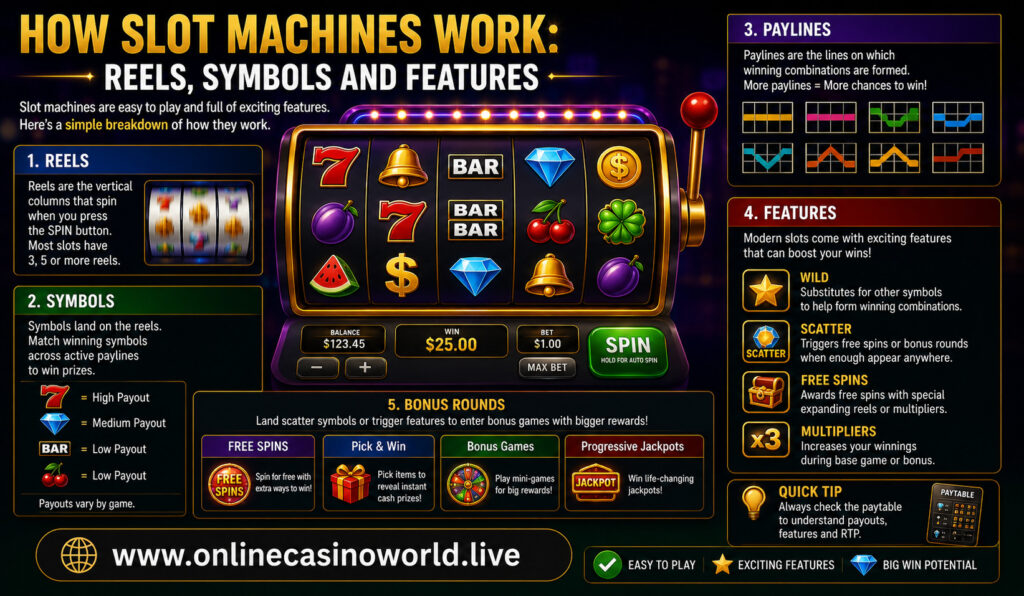
The reels are the columns that display symbols during a spin.
Traditional slot machines commonly used three physical reels. Modern video slots can feature three, five, or even more virtual reels.
A five-reel game might display several rows of symbols, creating numerous possible combinations.
The important point is that the visible reels are part of the game’s presentation. In modern electronic slots, the software determines the outcome, and the reels then display the corresponding symbols.
This is different from physically spinning a collection of independent objects and simply observing where they stop.
What Are Slot Symbols?
Symbols are the images displayed on the reels.
Common symbols include fruits, numbers, playing-card icons, themed characters, and special graphics designed around the game’s theme.
Symbols can have different functions.
Regular symbols typically contribute to standard winning combinations.
Wild symbols may substitute for certain other symbols.
Scatter symbols can activate bonus features or free-spin mechanics in some games.
Bonus symbols may trigger special rounds.
The exact function of each symbol is explained in the game’s paytable.
How Winning Combinations Work
A slot machine generally awards a result when the symbols form a combination defined by the game’s rules.
For example, a game might require matching symbols across a particular payline.
Other modern games use alternative systems such as ways-to-win mechanics, cluster pays, or expanding symbol arrangements.
This means there is no single universal method for determining a winning combination.
The paytable is therefore one of the most important screens for understanding a particular slot game.
What Are Paylines?
A payline is a specific pattern across the reels that can determine whether a combination qualifies for a payout.
Older slot machines often used a small number of paylines.
Modern games can have many paylines or may use completely different systems.
A five-reel game, for example, might allow combinations to form across horizontal, diagonal, or other predefined patterns.
The number of paylines does not mean that every spin will produce a winning combination. The game’s mathematical model determines how frequently different outcomes occur.
What Is a Random Number Generator?
The Random Number Generator (RNG) is one of the most important components of an electronic slot machine.
An RNG continuously produces sequences of numbers or values at extremely high speed.
When a spin is initiated, the game uses the relevant RNG output to determine the result according to its programmed rules.
The visual reels then display the symbols corresponding to that outcome.
This is why trying to predict a slot machine from the previous few spins is unreliable.
If a machine has recently displayed several losing results, that does not mean a winning combination is automatically due.
Are Slot Machine Results Random?
Modern regulated electronic slot machines are designed to produce outcomes using random or pseudo-random processes.
The exact implementation depends on the machine, software, and regulatory requirements.
Randomness means that unusual sequences can occur.
A machine can produce several similar results in succession, or a particular symbol may appear frequently for a period and then appear less often.
These patterns do not necessarily indicate that the machine is changing its odds in response to individual results.
Understanding the Paytable
The paytable explains how a particular slot game works.
It usually shows:
- Symbol values
- Winning combinations
- Special-symbol functions
- Bonus requirements
- Free-spin rules
- Wild and scatter behavior
- Other game-specific features
Before playing or analyzing a slot game, reading the paytable can provide a much clearer understanding of the mechanics.
Two machines can look almost identical but have very different mathematical models and feature structures.
What Is Return to Player?
Return to Player, commonly abbreviated as RTP, is a theoretical percentage describing the amount a game is designed to return over a very large number of plays.
For example, a game with a theoretical RTP of 96% is mathematically designed to return approximately ₹96 for every ₹100 wagered over a sufficiently large sample, while the remaining amount represents the theoretical house advantage.
This does not mean a player will receive exactly 96% back during an individual session.
Short-term results can vary substantially because of randomness.
RTP is therefore a long-term statistical concept, not a guarantee of an individual outcome.
What Is the House Edge?
The house edge represents the mathematical advantage retained by the operator over the long term.
If a game has a theoretical RTP of 96%, the corresponding theoretical house edge is approximately 4%.
These figures are useful for understanding the mathematical structure of a game, but they do not predict what will happen during a short sequence of spins.
A player could experience a winning session, a losing session, or a highly variable series of results.
What Is Slot Volatility?
Volatility, sometimes called variance, describes the general pattern of payouts in a slot game.
A lower-volatility game may produce smaller outcomes more frequently, while a higher-volatility game may produce less frequent but potentially larger outcomes.
Volatility does not tell a player whether the next spin will win.
It is better understood as a characteristic of the game’s overall payout distribution.
Two games with similar RTP percentages can have very different volatility profiles.
Understanding Wild Symbols
Wild symbols are special symbols that can substitute for other symbols under certain rules.
For example, a wild might replace a regular symbol to complete a winning combination.
However, wilds do not always substitute for every symbol. Some may have restrictions or additional functions.
A wild symbol can also trigger other features in certain games.
The paytable explains exactly how the wild operates.
Understanding Scatter Symbols
Scatter symbols are often associated with bonus features.
Unlike regular symbols, scatters may not need to appear on a traditional payline to perform their function.
A certain number of scatter symbols may trigger free spins or another bonus round.
The rules differ considerably from one slot game to another.
Therefore, the appearance of a scatter symbol does not automatically mean the same thing across all machines.
What Are Bonus Features?
Modern slots frequently include features designed around the game’s theme.
Examples include:
- Free-spin rounds
- Multipliers
- Bonus games
- Expanding symbols
- Re-spins
- Wild features
- Progressive jackpots
These features can make the gameplay more visually complex.
However, they are still governed by the game’s programmed rules and mathematical model.
A bonus feature does not remove randomness from the underlying game.
What Are Progressive Jackpots?
Some slot machines are connected to progressive jackpot systems.
A progressive jackpot can increase as qualifying wagers are made across one machine or a network of connected games.
The jackpot mechanics depend on the specific system.
Progressive games often have additional rules explaining eligibility, qualifying combinations, and jackpot conditions.
Because the jackpot value can change over time, it is important to distinguish the advertised jackpot amount from the game’s overall mathematical characteristics.
Physical Slots vs Digital Slots
Traditional mechanical slots used physical reels, levers, and mechanical components.
Modern slot machines are predominantly electronic.
Digital systems allow developers to create more complex themes, multiple paylines, animations, bonus rounds, and interactive features.
Online slots use similar digital concepts but display the game through software rather than a physical cabinet.
The presentation may differ, but the underlying idea of programmed outcomes and random-number generation remains central to modern electronic slot games.
Can Previous Spins Predict the Next Spin?
One of the most common misconceptions about slot machines is that previous results determine what will happen next.
They do not.
If a machine has produced several losing outcomes in a row, there is no mathematical rule saying that a winning outcome must follow.
Likewise, a recent jackpot does not necessarily make another jackpot immediately less likely.
Each spin is evaluated through the game’s mathematical system.
This is an example of why the gambler’s fallacy can be misleading when applied to random games.
Do Slot Machine Strategies Work?
Unlike some games that involve player decisions, slots generally provide very limited control over the actual outcome.
Choosing a particular machine, changing the spin amount, or waiting for a certain pattern does not provide a reliable method for predicting the next result.
The game’s programmed mathematics determine the probabilities.
No betting system can turn a random slot machine into a guaranteed source of income.
Why Slot Machines Use Sounds and Visual Effects
Sounds, animations, lights, and celebratory graphics are important parts of modern slot-machine design.
They help communicate events such as winning combinations, bonus triggers, and feature activations.
Some games may even use celebratory effects for outcomes that return less than the amount wagered, depending on the game’s design.
These audiovisual elements are part of the user experience and should not be confused with the underlying mathematical probability of a result.
Responsible Gambling Considerations
Slot machines involve financial risk when played for money.
Their fast pace can make it easy to continue playing without carefully considering how much has already been spent.
Anyone who chooses to gamble should understand the risks, follow applicable laws, set a firm spending limit, and avoid using money required for essential expenses.
It is also important not to chase losses by increasing spending after unsuccessful results.
If gambling becomes difficult to control, seeking support from a qualified professional or appropriate gambling-help organization may be useful.
Final Thoughts
Modern slot machines combine software, random number generation, reels, symbols, and programmed features to create an interactive gaming experience.
The reels provide the visual display, while symbols determine the combinations recognized by the game’s rules. Features such as wilds, scatters, free spins, multipliers, and progressive jackpots add additional layers to individual games.
For beginners, the most important concepts to understand are the RNG, paytable, paylines, RTP, and volatility. These explain much of what happens behind the colorful graphics and animations.
Most importantly, slot outcomes are based on chance. Previous spins cannot reliably predict future results, and no strategy can guarantee a winning outcome. Understanding how the technology works provides a more realistic view of what happens every time a slot machine is spun.