Ways-to-Win Slots vs Megaways Games and Their Design Differences
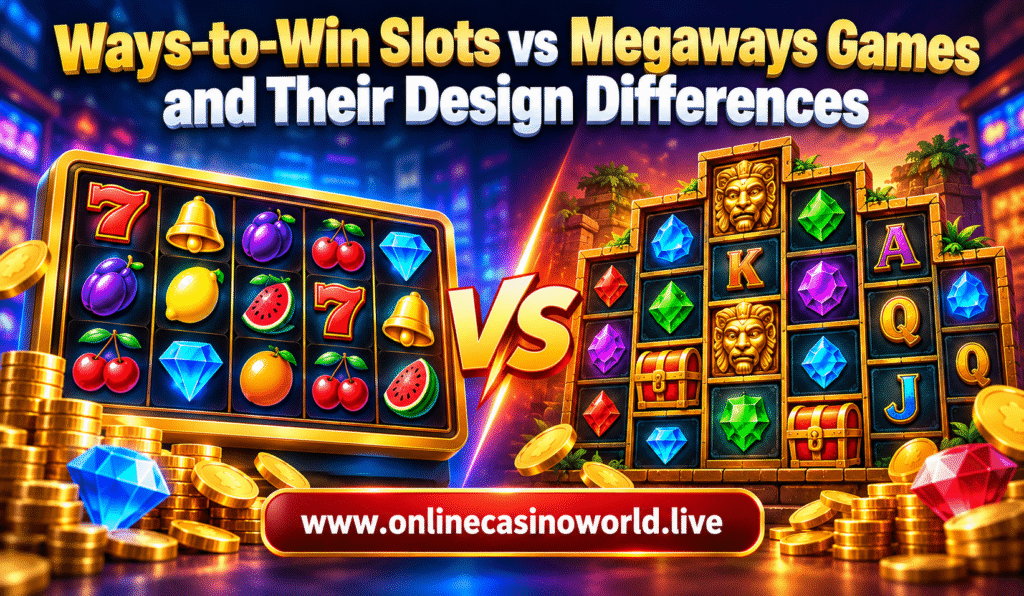
Online slot games use different systems to determine how matching symbols create winning combinations. Two popular approaches are fixed ways-to-win slots and Megaways games. Both move beyond traditional paylines, but they differ in how reel layouts are arranged, how combinations are calculated, and how the number of available winning ways changes during gameplay.
Understanding these differences helps readers explore modern slot mechanics without confusing a large combination count with a guaranteed advantage. Fixed ways-to-win slots generally use a consistent number of symbol positions, while Megaways games change reel heights from spin to spin. This difference influences their presentation, mathematical structure, and overall playing experience.
Understanding Ways-to-Win Slots
Ways-to-win slots are designed to recognize matching symbols across consecutive reels without requiring them to follow predetermined payline patterns. In a traditional payline game, symbols must appear along a specific route. A ways-to-win game removes that requirement and evaluates qualifying symbols wherever they appear vertically on adjacent reels.
Many standard ways-to-win games use a fixed grid. For example, a five-reel game might display three symbols on every reel. If matching symbols appear on consecutive reels beginning with the leftmost reel, the combination can qualify for a payout according to the game’s rules.
The number of possible ways is calculated by multiplying the available symbol positions across the reels. A five-reel arrangement with three positions per reel has 243 theoretical ways, calculated as three multiplied by itself five times.
If each of five reels displays four symbols, the total becomes 1,024 ways. These figures describe the available positional combinations under the stated layout, not the number of guaranteed winning outcomes.
The important characteristic is consistency. In a fixed ways-to-win slot, the number of symbol positions normally remains unchanged between ordinary spins. This makes the layout easier to understand because players do not need to recalculate the available ways every time the reels stop.
What Are Megaways Games?
Megaways is a variable-reel mechanic developed by Big Time Gaming and licensed for use in different slot releases. Instead of maintaining a fixed number of symbols on every reel, the system changes the visible reel heights between spins.
Many Megaways games use six reels, with each reel displaying a varying number of symbols. In a commonly used configuration, individual reels can display between two and seven symbols, although specific implementations and game rules should always be checked.
Because reel heights change, the number of available ways also changes. A spin with shorter reels may produce relatively few ways, while a spin with taller reels can create substantially more positional combinations.
When all six reels display seven symbols, the theoretical maximum is 117,649 ways. This figure comes from multiplying seven positions across six reels.
However, that maximum is not present on every spin. The number of ways depends on the reel configuration generated for each individual result.
Megaways therefore combines a ways-to-win payout system with variable reel heights. The changing layout is its defining characteristic, distinguishing it from fixed ways-to-win games.
Fixed Ways-to-Win vs Megaways: The Main Differences
The primary difference is the arrangement of symbol positions. Fixed ways-to-win slots generally display a stable grid, while Megaways games can change the number of visible symbols on each reel.
This distinction affects the way players interpret the screen. In a fixed-grid game, the layout remains familiar from one spin to the next. In a Megaways game, the reels may expand or contract, changing the total number of possible combinations.
The calculation method is related in both formats. Each uses matching symbols across consecutive reels, subject to its specific rules. However, the number of available positional combinations is fixed in a conventional ways-to-win game and variable in a Megaways game.
The visual experience also differs. Fixed layouts can feel structured and predictable in presentation, while changing reel heights create more movement and variation. Both formats can include bonus rounds, wild symbols, free spins, and other features, so these elements alone do not define the difference.
Neither design automatically offers better payouts. The game’s paytable, symbol distribution, return to player, and volatility determine how its mathematical model operates.
How the Number of Ways Is Calculated
Understanding the basic calculation makes both formats easier to compare. In a ways-to-win game, the number of symbol positions on each reel is multiplied together.
Consider a five-reel slot displaying three symbols on every reel. The calculation is three multiplied by three, five times, producing 243 ways.
A five-reel game with four visible symbols per reel produces 1,024 ways. Because the number of positions remains fixed, the theoretical ways count normally stays the same on each standard spin.
In a six-reel Megaways game, the calculation uses the number of visible symbols on each reel for that particular spin. If the reels display different heights, the calculation multiplies those individual counts together.
For example, a configuration showing three, four, five, two, six, and three symbols produces 2,160 ways. The calculation is three multiplied by four, five, two, six, and three.
If the reel heights change on the next spin, the number of ways changes accordingly. This is why Megaways games can display different ways counts throughout a session.
These calculations describe possible symbol-position combinations, not guaranteed wins or independent probabilities. The game’s complete mathematical model determines the likelihood and value of actual payouts.
How Winning Combinations Work
Both formats commonly recognize matching symbols beginning on the leftmost reel and continuing across consecutive reels. The exact minimum number of matching reels depends on the game’s rules.
In a fixed ways-to-win game, matching symbols can appear in different vertical positions without following a predefined line. If the required symbols occur on consecutive reels, the game evaluates the qualifying combination.
Megaways uses a similar principle, but the number of symbol positions available on each reel changes. This creates different opportunities for symbols to appear across the reel sequence.
Some games include multiple copies of a matching symbol on one reel. Depending on the game’s calculation rules, these positions can contribute to multiple winning combinations.
Wild symbols may substitute for regular symbols, while scatter symbols can activate separate bonus features. These functions vary by title and should not be assumed to operate identically across different games.
Players should review the paytable to learn which symbols qualify, how many reels must match, and whether special symbols change the result.
Cascading Reels and Additional Features
Cascading reels frequently appear alongside ways-to-win mechanics, including many Megaways releases. However, cascading reels are a separate feature rather than an essential requirement of either format.
When a qualifying winning combination appears, the symbols involved may disappear. Other symbols move into the available spaces, and new symbols enter the grid. The game then checks the updated arrangement for another winning combination.
If another win forms, the process may repeat within the same paid spin. Some games also increase a multiplier during successive cascades, particularly in selected bonus rounds.
Megaways titles often combine variable reel heights with cascading symbols, creating a changing layout that can continue evolving after an initial win. Fixed ways-to-win games can also use cascades, multipliers, free spins, and expanding symbols.
These features influence the presentation and payout structure, but their effects depend on each game’s rules. A cascade can end without producing another win, and a multiplier only affects eligible payouts under its specified conditions.
Return to Player and Volatility
Return to player, commonly called RTP, represents the theoretical percentage of wagers a game returns over a very large number of plays. It does not predict the outcome of a particular session.
Volatility describes the general distribution of wins. Some games produce relatively frequent smaller payouts, while others may have longer periods without significant wins and occasional larger outcomes.
Fixed ways-to-win games and Megaways titles can have different RTP values and volatility levels. It would be inaccurate to assume that Megaways automatically offers better odds because its maximum ways count is larger.
The number of ways is only one part of a game’s design. Symbol frequencies, payout values, bonus conditions, reel configurations, and other mathematical factors also influence the final experience.
Players comparing titles should consult the published game information rather than relying on the largest advertised number. A higher ways count does not guarantee that a particular spin will win or that the game will return more money.
Which Design Is Easier to Understand?
Fixed ways-to-win games may be easier for beginners to follow because the grid remains consistent. Players can learn the number of positions, understand the basic combination rules, and recognize how matching symbols create payouts.
Megaways games introduce an additional variable: reel height. Players must understand that the number of visible symbols and the available ways can change with every spin.
However, modern interfaces often display the current ways count and explain the main rules through an information panel. This can make the format accessible to readers who take time to understand its mechanics.
Neither system is universally easier or more suitable. Preferences depend on whether someone favours a stable layout or enjoys a changing reel arrangement.
A demonstration mode, when available, can help users understand the interface without placing real-money wagers. Reviewing the paytable remains useful in either format.
Responsible Considerations
Slot games are based on chance, and neither fixed ways-to-win systems nor Megaways mechanics can reliably predict future results. A larger ways count does not ensure a payout, and previous losses do not make a win due on the next spin.
Anyone choosing to play should establish clear spending and time limits beforehand. Gambling should be treated as entertainment rather than a dependable source of income, and money reserved for essential expenses should not be used for wagers.
Players should also follow applicable local laws, age requirements, and platform rules. Understanding the game’s mathematical information and recognizing the uncertainty of individual results can support more informed decisions.
Conclusion
Ways-to-win slots and Megaways games share a payout principle based on matching symbols across consecutive reels without requiring fixed payline patterns. Their main design difference lies in reel structure: conventional ways-to-win games generally use a stable number of symbol positions, while Megaways changes reel heights and recalculates the available ways from spin to spin.
This variable arrangement gives Megaways games a distinctive visual style, while fixed ways-to-win slots offer a more consistent layout. Both formats can include cascading reels, wild symbols, free spins, multipliers, and other bonus features.
Ultimately, a large ways count should not be confused with guaranteed success or superior mathematical value. Understanding reel layouts, payout rules, RTP, and volatility provides a clearer picture of how each format works and why individual games can produce different results.