Casino Game Paytables: How to Read Them
Casino games may look straightforward, but understanding how they pay can sometimes be confusing, especially for beginners. A game might have different symbols, paylines, bonus features, multipliers, and special rules that aren’t immediately obvious from the main screen.
This is why casino game paytables are so important. A paytable works like an instruction guide for a game. It explains which combinations can produce payouts, how much different symbols may be worth, and how special features work.
Learning to read a paytable doesn’t guarantee a win, but it can help you understand the game before you play. It also makes it easier to compare different games and avoid misunderstandings about their rules.
What Is a Casino Game Paytable?
A casino game paytable is a section that explains the payout structure and important rules of a casino game.
Paytables are particularly common in slot games. When you open one, you may see pictures of the game’s symbols alongside potential payouts. The same section may also explain wild symbols, scatters, bonus rounds, free spins, multipliers, jackpots, and other features.
Different games have different paytables. A classic slot may have only a few symbols and straightforward payouts, while a modern video slot could have several pages explaining its features.
The main purpose is simple: to explain what combinations and outcomes can produce payouts and under what conditions.
How to Find the Paytable
Most online casino games include an information or help button. Depending on the game, it could appear as a question mark, an “i” icon, a menu button, or a section called “Paytable” or “Game Rules.”
Clicking this option usually opens a screen containing information about the game.
On mobile devices, the paytable may appear in a separate window that you can scroll through. On desktop screens, it may open over the game interface.
It is a good idea to check this section before playing an unfamiliar game. Spending a minute understanding the rules can make the entire experience much clearer.
Start With the Basic Symbols
If you’re reading a slot paytable, begin by looking at the regular symbols.
Slots usually contain several symbols with different values. Some symbols may offer relatively small payouts, while others can have higher values when they appear in qualifying combinations.
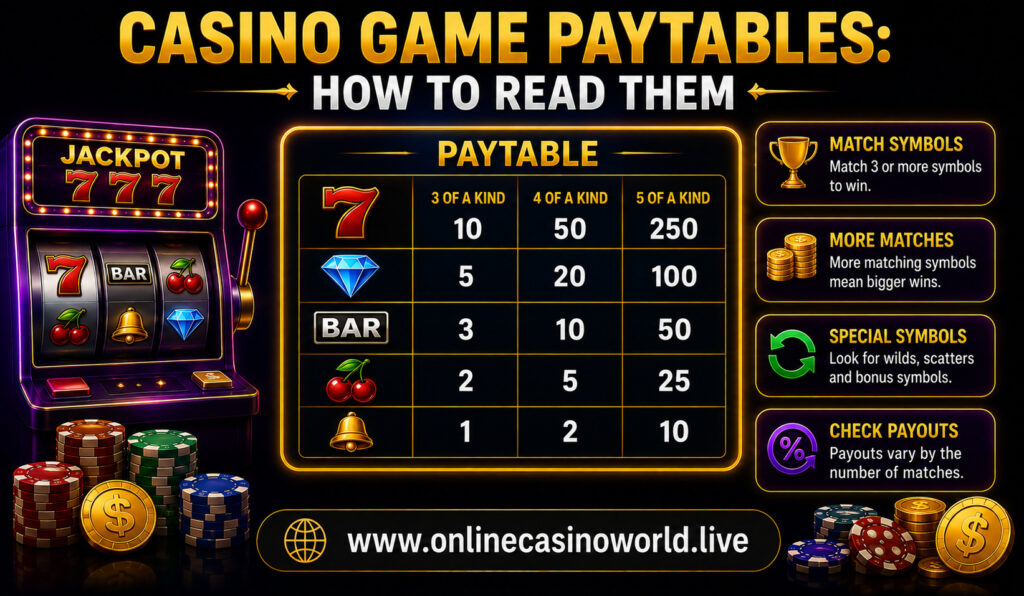
The paytable generally shows each symbol and the number of matching symbols required for a payout.
For example, a game could show different rewards for three, four, or five matching symbols. The actual values vary from one game to another, so never assume that a symbol has the same value across different slots.
The visual appearance of a symbol also doesn’t necessarily tell you how valuable it is. A simple-looking symbol could potentially pay more than a visually complicated one.
Understand How Winning Combinations Work
Knowing the symbols is only part of reading a paytable. You also need to understand how those symbols have to appear to create a win.
Traditional slots often use paylines. A payline is a specific pattern running across the reels. A winning combination must land along an eligible payline according to the game’s rules.
For example, a game might have winning lines running horizontally, diagonally, or through different reel positions.
However, not every modern slot uses traditional paylines. Some use systems such as ways to win, cluster pays, or other combination-based mechanics.
The paytable or help section should explain the exact system used by the game. This is important because two slots can look similar while calculating wins in completely different ways.
What Are Wild Symbols?
Wild symbols are another major feature you will often see in a paytable.
A wild generally acts as a substitute for certain regular symbols. Its purpose is usually to help complete a winning combination.
However, wilds don’t always behave identically. In one game, a wild may substitute for most regular symbols. In another, it may have additional abilities such as expanding, multiplying a win, or moving across the reels.
Some wilds may not substitute for scatter or bonus symbols.
That’s why it is important to read the description instead of assuming that every wild works the same way.
Understanding Scatter Symbols
Scatter symbols are also commonly explained in casino game paytables.
Unlike regular symbols, scatters often don’t need to appear on a traditional payline to provide their feature. Depending on the game, landing a certain number of scatters may award a payout, trigger free spins, or activate a bonus feature.
For example, a game might require three or more scatter symbols to trigger its bonus round.
The exact requirement varies, so check the paytable carefully. The number of scatters needed and the feature they activate can have a significant impact on how the game works.
Look for Bonus Features
Modern casino games often contain additional features beyond standard symbol payouts.
A paytable may explain features such as:
- Free spins
- Bonus rounds
- Multipliers
- Expanding symbols
- Retriggering features
- Sticky or locked symbols
- Wild modifiers
- Jackpot features
These features can make a game more complicated than a traditional slot.
For example, a multiplier might increase a qualifying win by a particular factor. An expanding wild might cover additional reel positions. A bonus round might use a completely different set of rules from the base game.
Reading these explanations beforehand helps you understand what happens when a special feature appears.
Check the Number of Reels and Ways to Win
The paytable may also provide information about the game’s basic structure.
Many slots use five reels, although other configurations are possible. The game may have a specific number of paylines or use a different winning mechanism altogether.
If a game uses paylines, check whether all paylines are active automatically or whether the player can adjust them.
Some games use “ways to win,” which can provide many possible winning combinations without relying on fixed lines. Others use cluster mechanics where matching symbols must appear next to each other.
Understanding the game’s winning structure is essential because the displayed symbol payouts may only apply when the required conditions are met.
Don’t Confuse Payout With Profit
One of the most important things to understand when reading a paytable is the difference between a payout and your actual profit.
Suppose a game displays a payout of ₹100 for a particular winning combination. That doesn’t automatically mean you have made ₹100 in profit. Your original stake and the game’s specific payout calculation need to be considered.
The value shown in the paytable may also depend on your bet size. Some games display payouts as multipliers of the stake rather than fixed currency amounts.
For this reason, always check how the game describes its payouts.
Look for RTP Information
Some casino games provide information about Return to Player (RTP).
RTP is a theoretical percentage representing the amount a game is designed to return over a very large number of plays. For example, a game with a theoretical RTP of 96% is designed so that, over an extremely large sample, approximately ₹96 would be returned for every ₹100 wagered.
This does not mean a player will receive ₹96 back from every ₹100 played. Short-term results can vary considerably.
RTP is therefore useful for understanding the game’s long-term mathematical design, but it should not be interpreted as a personal guarantee.
Check the Game’s Volatility
Some games also provide information about volatility, sometimes described as low, medium, or high.
Volatility relates to how frequently wins may occur and how large or small those wins tend to be. A lower-volatility game may generally feature more frequent but smaller wins, while a higher-volatility game can involve less frequent but potentially larger wins.
Volatility doesn’t tell you whether you will win or lose. It is simply another characteristic that can help explain the game’s payout pattern.
If volatility information is available, it is worth reading alongside the paytable rather than looking only at the largest advertised payout.
Pay Attention to Maximum Win Limits
Some modern casino games advertise a maximum possible win, often expressed as a multiple of the bet.
For example, a game could state that its maximum win is a certain number of times the wager. This doesn’t mean that the maximum payout is common or likely.
A maximum win simply describes the upper limit under the game’s rules. The probability of reaching it can be extremely different from the probability of achieving ordinary wins.
Therefore, don’t judge a game only by its biggest potential payout.
Paytables Can Differ Between Similar Games
One common mistake beginners make is assuming that games with similar designs work in the same way.
Two five-reel slots might have completely different payout structures. One could use traditional paylines, another could use ways to win, and another could use cluster-based combinations.
Even familiar symbols can have different values and functions.
Always read the specific paytable for the game you’re considering rather than relying on experience with another title.
A Simple Way to Read Any Paytable
You don’t need to memorize every detail. A simple approach is to work through the paytable in this order:
First, identify the regular symbols and their potential payouts. Next, find out how winning combinations are formed. Then check the wild and scatter symbols and understand what each one does.
After that, look for bonus features, free spins, multipliers, jackpots, and maximum-win information. Finally, check whether the game provides RTP or volatility details.
This gives you a basic understanding of the game’s mechanics without having to study every detail repeatedly.
Final Thoughts
Casino game paytables are more than just lists of numbers. They provide important information about how a game works and what conditions are required for different payouts.
By checking symbols, paylines, wilds, scatters, bonus features, RTP, volatility, and maximum-win rules, beginners can approach unfamiliar casino games with a clearer understanding of their mechanics.
Most importantly, a paytable should be viewed as an information tool, not a prediction tool. It can explain the mathematical structure and rules of a game, but it cannot predict the outcome of an individual spin or round. Casino games involve chance, so understanding the paytable should always go alongside responsible play and a clear spending limit.