
How Card Counting Works in Blackjack: The Basics
Blackjack is one of the few casino games where players can use mathematical strategies to influence their decisions. One of the most famous techniques associated with the game is card counting.
Card counting has been featured in movies, books, and casino stories for decades, but it is often misunderstood. Contrary to popular belief, it does not involve memorizing every card that has been dealt. Instead, card counting is a system for keeping track of the general balance of high and low cards that remain in the deck or shoe.
Understanding how card counting works can help beginners appreciate the mathematics behind blackjack. However, it is important to remember that card counting does not guarantee wins, requires significant practice, and casinos may take steps to prevent or discourage it.
What Is Card Counting?
Card counting is a blackjack strategy that attempts to estimate whether the remaining cards are favorable or unfavorable to the player.
The basic idea comes from the fact that not all cards have the same effect on blackjack probabilities.
High-value cards, particularly 10s, face cards, and aces, can be beneficial to players in certain situations. They can create more natural blackjacks and can make doubling down more attractive in some circumstances.
Low-value cards can benefit the dealer in certain situations because they help the dealer complete hands without immediately going over 21.
By keeping a running count of the cards that have already appeared, a player can estimate the composition of the remaining cards.
Why Does Card Counting Work?
To understand card counting, it helps to understand why the composition of the remaining deck matters.
Imagine a shoe containing a relatively high proportion of 10-value cards and aces. These cards can increase the likelihood of certain player-favorable outcomes, including natural blackjack.
If many high cards have already been dealt, the remaining shoe may contain proportionally more low cards.
Card counting attempts to identify these changes.
The strategy does not predict the exact next card. Instead, it estimates whether the remaining deck is relatively rich or poor in high-value cards.
This information can theoretically help a player make better betting and playing decisions.
The Hi-Lo Counting System
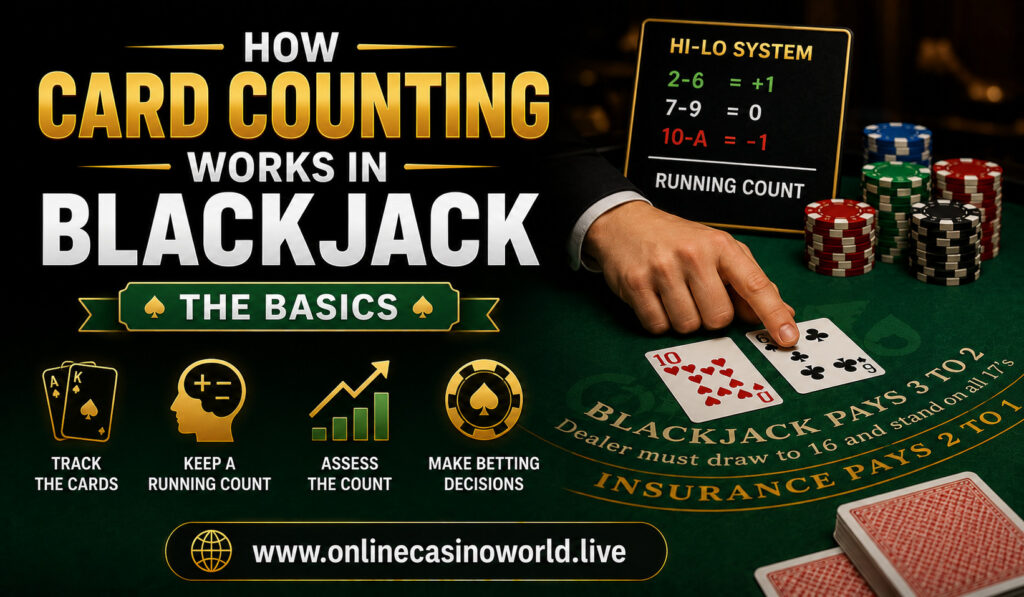
One of the best-known beginner card-counting systems is the Hi-Lo system.
It assigns simple values to different card groups:
- Cards 2 through 6: +1
- Cards 7 through 9: 0
- 10s, face cards, and aces: -1
The player keeps a running total as cards are dealt.
For example, suppose the cards appearing are:
5, 8, King, 3, Ace
Using the Hi-Lo system:
- 5 = +1
- 8 = 0
- King = -1
- 3 = +1
- Ace = -1
The running count would therefore return to 0.
The purpose is not to memorize the individual cards but to track the overall balance.
What Is a Running Count?
The running count is the total produced by adding the assigned values of the cards that have been dealt.
Suppose a player observes:
2, 4, 9, Queen, 6
Using Hi-Lo:
2 = +1
4 = +1
9 = 0
Queen = -1
6 = +1
The running count becomes +2.
A positive count generally suggests that more high-value cards remain compared with a neutral deck composition.
A negative count suggests that more low-value cards remain.
However, the running count alone may not be enough when a casino uses multiple decks.
What Is the True Count?
When blackjack is played with several decks, card counters may convert the running count into a true count.
The true count adjusts the running count based on the estimated number of decks remaining.
The basic idea is:
True Count = Running Count ÷ Estimated Decks Remaining
For example, if the running count is +6 and approximately three decks remain, the estimated true count would be +2.
This adjustment allows the player to compare the count more consistently as the number of remaining cards changes.
Estimating how many decks remain accurately is one of the skills that makes card counting difficult.
How Does the Count Affect Strategy?
A card count does not replace basic blackjack strategy.
Instead, counting is generally used alongside basic strategy.
Basic strategy tells a player how to make mathematically appropriate decisions based on factors such as the player’s hand and dealer’s visible card.
Card counting attempts to provide additional information about the remaining deck.
When the remaining cards are estimated to be more favorable, a counter may adjust certain playing decisions or betting behavior.
The exact adjustments can become complicated, which is why professional-level card counting requires substantial practice.
Card Counting Is Not Memorizing Cards
One of the biggest misconceptions is that card counters memorize every card that appears.
Most basic counting systems do not require this.
Instead, players assign values to cards and maintain a running total.
This is similar to keeping a simple mathematical score while the game progresses.
However, doing this accurately while simultaneously watching the dealer, making blackjack decisions, handling chips, and avoiding distractions can be challenging.
That is one reason experienced card counters spend considerable time practicing.
Does Card Counting Guarantee a Win?
No.
Card counting does not guarantee that a player will win an individual hand, session, or even a particular trip to a casino.
Blackjack remains a game involving probability and variance.
A favorable count can indicate that the mathematical conditions are potentially better for the player, but random outcomes can still produce long losing streaks.
Card counting is therefore better understood as a method for attempting to gain a small mathematical advantage under suitable conditions, not as a guaranteed winning formula.
The Importance of Basic Blackjack Strategy
Anyone interested in card counting should understand basic blackjack strategy first.
Basic strategy is based on mathematical analysis of the player’s hand and the dealer’s visible card.
For example, whether to hit, stand, split, or double can depend on the exact situation.
A player who attempts to count cards without understanding basic strategy may still make poor decisions even if the count itself is accurate.
Card counting is therefore an advanced technique built on top of fundamental blackjack knowledge.
Betting and the Count
One of the most important aspects of traditional card counting is adjusting bet size based on the estimated favorability of the remaining cards.
When the count suggests a greater concentration of high-value cards, a counter may increase their wager. When the count becomes unfavorable, they may reduce it.
This is intended to place more money on situations where the player’s mathematical expectation may be stronger and less money when conditions are unfavorable.
However, larger bets also increase financial risk and variance.
Someone attempting to use such a system without sufficient bankroll management can experience significant losses.
Why Casinos Watch for Card Counters
Card counting itself generally involves mental arithmetic and does not require altering or manipulating casino equipment.
However, casinos may still consider it undesirable because a skilled counter can potentially reduce the house advantage under certain conditions.
As a result, casinos may monitor betting patterns and gameplay.
Depending on the casino and jurisdiction, possible responses can include asking a player to stop playing blackjack, changing the table conditions, or asking the player to leave.
Players should always follow the casino’s rules and applicable laws.
Card Counting in Online Blackjack
Card counting is much less useful in many forms of online blackjack.
In automated blackjack games, the cards may be generated through an RNG, and the virtual deck can be reshuffled or reset according to the game’s design.
If the deck composition is not carried over from one round to the next, there is little or no practical shoe information for a traditional counting system to exploit.
Live dealer blackjack can be different because real cards are physically dealt. However, the specific dealing and reshuffling procedures matter greatly.
Players should understand that a live dealer game is not automatically suitable for card counting.
Common Card Counting Myths
Card counting is surrounded by several myths.
One misconception is that a card counter can know exactly what card will appear next. That is not what the strategy does.
Another myth is that counting makes blackjack risk-free. It does not.
Some people also believe that casinos can instantly identify anyone who mentally counts cards. In reality, detection depends on factors such as betting patterns, playing behavior, table conditions, and casino surveillance.
Finally, card counting does not mean cheating by definition. However, casinos can establish their own rules and decide who they allow to play at their tables, subject to applicable law.
How Beginners Can Learn the Basics
Someone interested in learning card counting should begin with blackjack rules and basic strategy.
The next step is learning a simple counting system such as Hi-Lo and practicing it away from a casino.
A useful exercise is to take a standard deck of cards and assign each card its Hi-Lo value while maintaining a running count.
The goal is to reach an accurate count consistently without losing track.
After becoming comfortable with the running count, learners can study concepts such as true count conversion and basic strategy deviations.
There is no need to rush into real-money play while learning.
Responsible Gambling Still Matters
Even if someone understands card counting, blackjack remains financially risky.
A mathematical advantage, where it exists, is usually small and can be overwhelmed by short-term variance.
Players should never assume that counting guarantees regular income or use borrowed money to pursue gambling profits.
Setting a strict gambling budget and understanding personal financial limits are essential.
Gambling should be treated as entertainment, not as a dependable source of income.
Final Thoughts
Card counting works by tracking the changing balance of high and low cards in a blackjack shoe. Systems such as Hi-Lo assign simple values to cards, allowing players to maintain a running count and estimate whether the remaining deck may contain a higher or lower concentration of valuable cards.
More advanced counting involves concepts such as the true count, betting adjustments, and strategy deviations. However, even experienced counters cannot predict individual cards or guarantee winnings.
For beginners, the best starting point is to learn blackjack rules, understand basic strategy, and practice counting away from real-money games. Card counting is ultimately a mathematical technique that requires concentration, discipline, and a realistic understanding of risk.