Three Card Poker vs Casino Poker for New Players
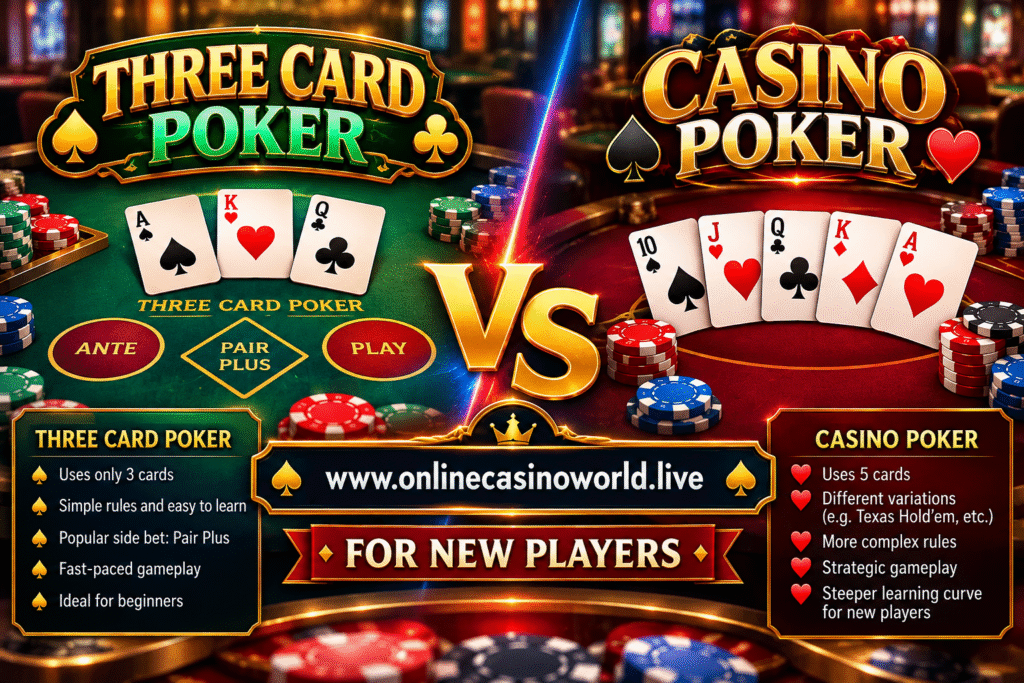
Choosing a poker-style casino game for the first time can feel confusing because several games use familiar cards but follow different rules. Three Card Poker and Casino Poker are two terms beginners may encounter while exploring casino gaming guides. Although both involve poker hands, their gameplay, betting decisions, and round structures can differ considerably.
Three Card Poker is a specific casino table game in which players receive three cards and compete against the dealer. Casino Poker, on the other hand, is a broader term that can describe several dealer-based poker variations, including Caribbean Stud Poker and Casino Hold’em. Understanding which version a table offers is essential before comparing its rules with Three Card Poker.
For readers of OnlineCasinoWorld.live, this guide explains the main differences, introduces essential poker terminology, and outlines what beginners should understand before exploring either format.
What Is Three Card Poker?
Three Card Poker is a casino card game played with a standard 52-card deck. Each participating player receives three cards, and the dealer also receives three cards. The player’s objective in the main game is to form a stronger three-card poker hand than the dealer’s qualifying hand.
Unlike traditional poker games, players do not compete against one another or try to win chips through bluffing. Instead, the casino follows predetermined rules for dealing, qualifying, and settling wagers.
A typical round begins with an ante, which is the initial wager. After receiving three cards, the player decides whether to fold or continue by placing a Play wager equal to the ante. The dealer then reveals the cards, and the game determines the outcome.
Some versions also offer Pair Plus, a separate wager based on the strength of the player’s three-card hand. This side bet follows its own payout schedule and can produce a different result from the main game.
The relatively small number of cards makes Three Card Poker straightforward to learn, although players still need to understand its hand rankings and betting conditions.
What Does Casino Poker Mean?
Casino Poker is not always the name of one specific game. It can refer generally to poker-based casino table games in which players compete against the house rather than other participants.
Examples include Caribbean Stud Poker, Casino Hold’em, and other dealer-banked variations. Each has its own rules, number of cards, betting sequence, and dealer qualification requirements.
Caribbean Stud Poker generally deals five cards to the player and dealer. Casino Hold’em uses community cards, allowing players to form a hand from their private cards and the shared cards on the table. These structures differ from Three Card Poker, where each hand consists of three cards.
The term Casino Poker may also appear as a category on an online gaming website. Consequently, beginners should identify the exact game before assuming that its rules match another poker variation.
Three Card Poker vs Casino Poker: The Main Differences
The most obvious difference is that Three Card Poker has a defined three-card format, while Casino Poker may refer to several games.
Three Card Poker normally offers a direct choice between folding and placing a Play wager after the initial deal. Other casino poker games may require additional decisions or use different betting structures.
The hand rankings also vary. In Three Card Poker, a straight typically beats a flush because three-card combinations have different probabilities from five-card hands. In conventional five-card poker rankings, a flush beats a straight.
Dealer qualification rules are another important distinction. In common Three Card Poker versions, the dealer must hold queen-high or better to qualify. Caribbean Stud Poker commonly requires at least ace-king high. Other casino poker formats may use different conditions or no equivalent qualification rule.
These differences affect how hands are compared and how wagers are settled. Reading the rules of the specific game is therefore more useful than relying on the general Casino Poker label.
How a Three Card Poker Round Works
A standard Three Card Poker round follows a simple sequence.
First, the player places an ante. An optional Pair Plus wager may also be available before the cards are dealt.
Second, the player and dealer each receive three cards. The player’s cards are available for inspection, while the dealer’s cards generally remain face down.
Third, the player chooses to fold or continue. Folding forfeits the ante in the main game. Continuing requires a Play wager equal to the original ante.
Finally, the dealer reveals the hand, qualification is checked, and the wagers are settled according to the table rules.
For example, a player with a pair of eights has a recognizable poker combination. Whether that hand wins the main wager depends on the dealer’s hand and qualification. If the dealer fails to qualify, the ante commonly wins even money and the Play wager is returned.
Understanding Three Card Poker Hand Rankings
Three Card Poker uses six principal hand categories. From highest to lowest, the usual ranking is:
- Straight flush: Three consecutive cards of the same suit.
- Three of a kind: Three cards of the same rank.
- Straight: Three consecutive cards that are not all the same suit.
- Flush: Three cards of the same suit that are not consecutive.
- Pair: Two cards of the same rank.
- High card: Three cards that do not form any of the combinations above.
This order is especially important for beginners familiar with five-card poker. A straight flush is the strongest ordinary three-card combination, while three of a kind ranks above a straight and a flush.
For example, a hand containing seven, eight, and nine of the same suit forms a straight flush. Three queens form three of a kind. A hand containing a two, five, and king of different suits, with no matching ranks or consecutive sequence, is evaluated as a high-card hand.
When two hands belong to the same category, their card ranks determine which one is stronger. Suits generally do not break ties.
How Other Casino Poker Games Differ
Caribbean Stud Poker uses five cards for both the player and dealer. After viewing the dealer’s exposed card, the player chooses whether to fold or raise. In common versions, the raise is twice the ante, and the dealer must generally qualify with ace-king high or better.
Casino Hold’em introduces community cards. Players combine their private cards with shared cards to make a five-card poker hand. Its betting decisions and dealer comparison rules differ from those of Three Card Poker.
Traditional poker-room games, such as Texas Hold’em, are different again. Participants compete against other players, and betting rounds, bluffing, and opponent behaviour are central parts of the experience. These games should not be treated as interchangeable with dealer-banked casino poker.
Understanding these categories prevents confusion when browsing online game menus or reading beginner guides.
The Role of Betting Decisions
Three Card Poker places considerable emphasis on the decision to fold or continue after receiving three cards. The player must assess the available hand without knowing the dealer’s complete cards.
A common basic-strategy guideline for standard Ante and Play rules is to continue with queen-six-four or a stronger hand, using the three-card hand ranking to evaluate the cards from highest to lowest. This guideline depends on the standard rules and should not be assumed to apply unchanged to every variant.
Other casino poker games can require different decisions. Caribbean Stud Poker involves five-card hand evaluation, while Casino Hold’em uses community cards and its own betting procedure.
No decision eliminates the house edge, and strategy guidance does not guarantee a winning outcome. Beginners should first learn the exact rules and understand how much they must wager to continue.
Understanding Side Bets and Payouts
Three Card Poker may offer Pair Plus, which pays according to the player’s own hand rather than the dealer comparison. A qualifying pair or stronger combination may earn a payout even when the main game produces a loss, depending on the rules.
Other casino poker games may provide different bonus wagers or progressive jackpot options. These are separate from the main game and can have distinct payout tables.
A large advertised payout does not necessarily indicate a favourable wager. Rare combinations often carry larger payments because they occur less frequently. The probability of winning and the payout terms both influence the theoretical value of a bet.
Players should examine whether the displayed payout represents profit alone or the total amount returned, including the original stake. They should also check whether a side bet can be placed independently or requires a main wager.
Which Game Is Easier for Beginners?
Three Card Poker is often easier to understand initially because it uses only three cards and offers a limited main-game decision. Beginners can learn the hand rankings and the fold-or-continue choice without managing community cards or several betting rounds.
However, another casino poker variation might suit someone who prefers a five-card hand or a game with additional decisions. The best choice depends on the player’s familiarity with card rankings and willingness to learn a particular set of rules.
Ease of learning should not be confused with the likelihood of making money. All casino games have rules that influence their mathematical outcomes, and a simple game can still result in losses.
A sensible starting point is to study the rules, review the payout table, and use a free practice version if one is available. Practice can improve familiarity with the interface but cannot predict future cards.
Online Casino Poker and Responsible Play
Online versions of poker-style casino games may use random-number generators or live dealers. Although their presentation differs, players should still review the rules, qualification requirements, payout schedules, and available betting limits.
Before using a platform, check its licensing information and whether participation is legal in your location. Only adults who meet the applicable legal age requirements should participate in real-money gambling.
Set a fixed entertainment budget and a time limit before beginning. Never borrow money to gamble, chase previous losses, or assume that a winning streak will continue. If gambling begins to affect essential expenses or personal well-being, stop and seek appropriate support.
Final Thoughts
Three Card Poker and Casino Poker share a connection to traditional poker hands, but they are not necessarily the same game. Three Card Poker is a specific three-card format with an ante, a Play decision, dealer qualification, and optional wagers such as Pair Plus. Casino Poker can describe several games, including Caribbean Stud Poker and Casino Hold’em, each with its own dealing procedures and betting rules.
For new players, the most important step is to identify the exact game and learn its hand rankings, betting sequence, and settlement conditions. Three Card Poker may offer a simpler introduction, while other casino poker variations provide different structures and decisions.
For OnlineCasinoWorld.live readers, understanding these differences makes it easier to compare game formats without confusing their rules or payouts. Every casino game involves uncertainty, and no strategy guarantees profit. Treat gambling as entertainment, understand the risks, and make informed decisions within clear personal limits.