Sic Bo Explained Through Dice Combinations and Table Layouts
Sic Bo is a traditional dice game that has become familiar to casino enthusiasts because it combines simple rules with a wide selection of betting possibilities. Unlike card games, which depend on the value of dealt cards, Sic Bo revolves around the results of three six-sided dice. Players predict different aspects of the upcoming roll, including the total, individual numbers, matching faces, and specific combinations.
For beginners, the betting table can initially appear complicated. Numerous numbered sections, dice symbols, and payout labels may make it difficult to understand where each wager belongs. However, learning the basic dice combinations and recognizing the main areas of the layout makes the game much easier to follow.
This guide for OnlineCasinoWorld.live explains how Sic Bo works, what its common betting sections represent, how combinations are formed, and why understanding probability is important.
What Is Sic Bo?
Sic Bo is a game of chance played with three six-sided dice. The name is associated with traditional Chinese dice gaming, and the game is now available in various casino formats, including physical tables, electronic systems, and online versions.
Before a round begins, players select one or more betting areas and place their stakes. The dice are then rolled, and the result determines which wagers qualify for payment. Each die can show a number from one through six, producing a combined total between three and eighteen.
The important point is that players are not trying to control the dice. They are predicting what the roll might produce. A wager might focus on the total, whether the result falls within a particular range, or whether two or three dice show matching numbers.
Different Sic Bo versions may use different layouts and payouts. Therefore, the rules displayed at a particular table should always be treated as authoritative.
Understanding the Three Dice
Every standard Sic Bo round uses three dice. Each die has six possible faces, numbered from one to six. When the three results are added together, the smallest possible total is three, while the largest is eighteen.
For example, a roll showing two, four, and five produces a total of eleven. A result of three, three, and six produces twelve. Meanwhile, three dice showing four create a total of twelve and form a triple.
Although these examples can have identical or different totals, their combinations are not necessarily equivalent. Some wagers depend only on the sum, while others require particular faces or matching numbers.
Three dice create 216 equally likely ordered outcomes when each die is fair and independent. This explains why some results occur more frequently than others. Central totals can be produced in several ways, whereas the lowest and highest totals have only one possible combination each.
Understanding this distinction provides a useful foundation for interpreting the betting layout.
How the Sic Bo Table Layout Works
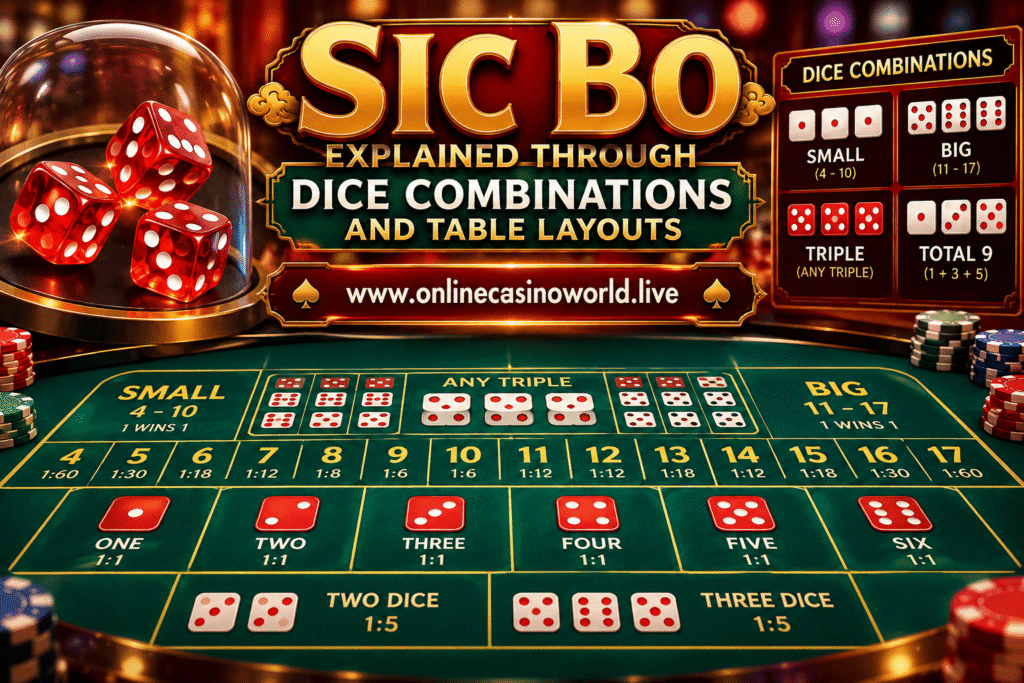
The table layout is a visual guide to the wagers available in a game. Each marked section represents a particular prediction, and the payout information indicates how a qualifying result is settled.
Although designs differ, most layouts include several familiar areas.
Big and Small: These sections predict whether the total will fall within a lower or higher range.
Odd and Even: These sections concern whether the combined total is odd or even, where offered.
Specific totals: These areas allow predictions on totals such as four, eight, ten, twelve, or seventeen.
Single-number bets: These wagers predict whether a selected face appears on one or more dice.
Doubles and triples: These areas cover matching numbers, including results such as two sixes or three threes.
Combination bets: These wagers predict that particular numbers will appear together among the three dice.
Rather than memorizing the entire table immediately, beginners can learn one category at a time. Reading the label, identifying the required outcome, and checking the payout is a straightforward way to understand each section.
Big and Small Bets Explained
Big and Small are among the most recognizable Sic Bo wagers. In many standard versions, Small covers totals from four through ten, while Big covers totals from eleven through seventeen.
A total of eight would ordinarily qualify as Small. A total of thirteen would qualify as Big. However, an important exception commonly applies: if all three dice show the same number, both Big and Small lose, even when the total falls within the relevant range.
For example, a roll of two, two, and two produces a total of six. Although six falls within the Small range, the triple usually disqualifies the Small wager.
These bets are relatively easy to understand because they focus on a range rather than an exact combination. Nevertheless, their settlement conditions must be checked before placing a wager.
Odd and Even Predictions
Odd and Even bets focus on the parity of the combined dice total. An odd total includes results such as five, nine, eleven, and fifteen. Even totals include six, eight, twelve, and sixteen.
The distinction concerns the sum rather than whether individual dice display odd or even numbers. For example, a roll of one, two, and four produces seven, which is odd. A roll of two, four, and six produces twelve, which is even.
Some versions exclude triples from these wagers, so the table rules matter. Players should also avoid assuming that an odd result becomes more likely after several even results. Previous independent rolls do not determine the next outcome.
Understanding Specific Total Bets
Specific-total wagers require the three dice to add up to an exact number. Common betting areas include totals from four through seventeen, although the minimum and maximum possible totals are three and eighteen.
Consider a prediction on ten. Several combinations can produce that result, including one, three, and six; two, three, and five; or three, three, and four.
The number of combinations matters because it influences the probability of a total appearing. Ten and eleven can each be formed in 27 of the 216 equally likely ordered outcomes. By contrast, three and eighteen each have only one possible outcome.
This difference helps explain why payout schedules vary across total bets. Less frequent outcomes may attract higher advertised payouts, but a larger payout does not automatically make a wager more favourable. The probability and the exact payment terms must be considered together.
Doubles and Triples
A double occurs when two dice show the same number. Examples include one, one, four and five, five, two. The third die does not need to match the pair.
A specific-double wager usually predicts a particular matching pair, such as two threes. The third die may show another number, depending on the rules of that wager.
A triple occurs when all three dice display the same face. Examples include one, one, one and six, six, six. A specific-triple wager predicts one particular triple, whereas an Any Triple wager covers every possible triple from one through six.
There are six specific triples among the 216 equally likely ordered outcomes. Consequently, an Any Triple result occurs in six outcomes, or one out of every 36 equally likely rolls on average.
That does not mean a triple will appear every 36 rounds. Random outcomes do not follow a fixed schedule, and long gaps between rare results are possible.
Single-Number and Combination Bets
Single-number wagers focus on whether a selected face appears among the three dice. Depending on the version, the payout can depend on whether that number appears once, twice, or three times.
For example, choosing four wins under a one-appearance condition if the result includes a four. A roll of four, two, and six contains one four, while four, four, and one contains two. These outcomes may receive different payments under the displayed rules.
Combination wagers focus on two selected numbers appearing together. A prediction involving two and five, for instance, requires both numbers to appear among the three dice. The third die may show another number or repeat one of the selected faces, depending on the particular combination rules.
Always distinguish between a wager requiring two different numbers and one requiring a specific pair or triple. Similar-looking table sections can have different winning conditions.
Reading Payouts Correctly
A payout table explains how much a successful wager returns. Some tables express payments as winnings relative to the original stake, while others show the total return, including the stake. These formats should not be confused.
For example, if a hypothetical wager pays five to one in winnings, a successful stake of ten units earns fifty units in winnings, with the original stake handled according to the stated settlement convention.
Actual Sic Bo payouts vary by operator, jurisdiction, and game version. A payout shown on one table should not be assumed to apply elsewhere.
Before participating, check the minimum and maximum stakes, the payout schedule, the treatment of triples, and the rules for combination bets. These details are more important than relying on a general description of the game.
Probability and Common Misunderstandings
Sic Bo is a chance-based game, and no betting method can guarantee a profitable result. Understanding probability can explain why certain combinations occur more often, but it cannot reveal the next roll.
One common misunderstanding is the belief that a number becomes due after remaining absent for several rounds. Another is assuming that repeated doubles make a triple more likely on the next attempt. Neither conclusion follows from independent, fair dice rolls.
Players should also avoid judging a wager solely by its advertised payout. A high payment can correspond to an outcome that occurs relatively rarely, and the house edge depends on both the probability and the payout terms.
A useful approach is to learn the rules first, understand the conditions attached to each bet, and avoid making decisions based on patterns that have no predictive value.
Online Sic Bo and Digital Table Designs
Online versions generally present the betting layout as an interactive screen. Players select a betting area, choose a stake, and confirm their selections before betting closes. After the roll, the result is displayed and eligible wagers are settled.
Some games use automated dice systems, while others provide live-dealer presentations. The visual experience may differ, but the underlying principles remain similar.
Before using an online platform, review its rules, payment terms, age requirements, and local legal restrictions. A demonstration mode, where available, may help beginners become familiar with the interface without placing real-money wagers.
Responsible Play and Final Thoughts
Sic Bo becomes easier to understand when its layout is divided into categories: total predictions, Big and Small, Odd and Even, single numbers, doubles, triples, and combinations. Each section represents a different condition that the dice must satisfy.
The most useful starting point is to understand how three dice create totals and why some combinations are more common than others. Once these basics are clear, payout tables and betting labels become easier to interpret.
Remember that a simple layout does not remove the uncertainty of gambling. Set a firm entertainment budget, never chase losses, and stop if participation becomes stressful or affects essential expenses. Only adults who are legally permitted to gamble should participate.
For OnlineCasinoWorld.live readers, learning the mechanics of Sic Bo offers a clearer understanding of this traditional dice game without relying on myths or promises of guaranteed outcomes. Knowing the combinations, reading the table carefully, and recognizing the limits of probability are the foundations of an informed approach.