
European Roulette vs American Roulette Explained
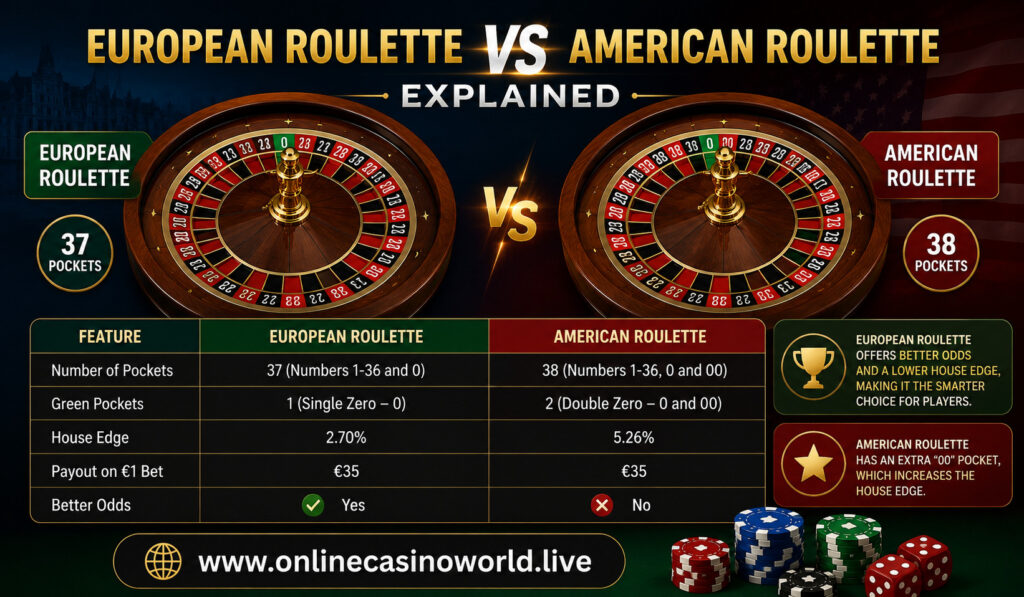
Roulette is one of the most recognizable casino games, but not all roulette wheels are exactly the same. Two of the most widely known versions are European Roulette and American Roulette. While both follow the same basic concept, an important difference in the number of pockets changes the mathematical odds.
For beginners, understanding this distinction is useful because the wheel layout affects the probability of different outcomes and the casino’s built-in mathematical advantage. European Roulette has a single zero, while American Roulette has both a zero and a double zero.
In this guide, we explain the differences between European and American Roulette, including their wheel layouts, rules, probabilities, house edges, and key terms.
What Is European Roulette?
European Roulette, sometimes called single-zero roulette, uses a wheel containing 37 pockets.
The pockets are numbered from 0 to 36. Numbers 1 through 36 are divided between red and black, while the 0 pocket is green.
The presence of only one zero is the defining feature of this version.
A standard European Roulette wheel therefore contains:
- 18 red numbers
- 18 black numbers
- 1 green zero
The wheel’s design means that a single-number prediction has one chance out of 37 of matching the winning pocket.
European Roulette is widely recognized for having a lower mathematical house edge than American Roulette.
What Is American Roulette?
American Roulette uses a wheel with 38 pockets.
Instead of having only one zero, it has:
- 18 red numbers
- 18 black numbers
- 1 green 0
- 1 green 00
The additional 00 pocket is the most important difference between American and European Roulette.
The double-zero pocket creates an additional possible outcome. Although the table may look very similar to a European Roulette table, this extra pocket changes the probability calculations.
A single-number prediction on an American Roulette wheel has one chance out of 38 of matching the winning pocket.
European Roulette vs American Roulette: The Main Difference
The easiest way to remember the difference is simple:
European Roulette = 0
American Roulette = 0 and 00
Both versions contain numbers 1 through 36. The difference is the additional green 00 pocket on the American wheel.
This may seem like a small change, but it has a significant mathematical effect.
In European Roulette, there are 37 possible pockets. In American Roulette, there are 38.
That additional pocket gives the casino a larger mathematical advantage on standard bets.
Comparing the House Edge
The house edge represents the mathematical advantage built into the game over a large number of spins.
For standard bets, the theoretical house edge is approximately:
European Roulette: 2.70%
American Roulette: 5.26%
The difference comes primarily from the extra zero.
It is important to understand what these percentages mean. They do not mean that a player will automatically lose 2.70% or 5.26% during a particular session. Short-term results can vary significantly because individual roulette spins are random.
Instead, the figures describe the long-term mathematical expectation built into the game.
Why Does the Extra 00 Matter?
At first, the 00 pocket may look like nothing more than another green space on the wheel. Mathematically, however, it makes a major difference.
Consider a simple red-or-black outcome.
A European Roulette wheel has 18 red pockets and 18 black pockets, plus one green zero.
That means there are 37 possible pockets, but only 18 correspond to red.
American Roulette has the same 18 red and 18 black pockets but adds both 0 and 00.
There are therefore 38 possible pockets, with only 18 corresponding to red.
The extra green pocket reduces the probability of hitting a particular outside bet.
Number Bets in Both Versions
A straight-up number bet is based on a single number.
In European Roulette, there are 37 possible pockets. Therefore, the probability of the ball landing on a selected number is:
1 ÷ 37
In American Roulette, there are 38 possible pockets:
1 ÷ 38
The difference may appear small on an individual spin, but it becomes important when considering the long-term mathematical structure of the game.
Red and Black Bets
Red and black are among the simplest roulette categories.
European Roulette has 18 red, 18 black, and one green zero.
American Roulette has 18 red, 18 black, one green zero, and one green 00.
Therefore, neither version provides a mathematically exact 50/50 chance for red versus black.
The green pockets are what prevent these outcomes from being perfectly even.
The additional 00 in American Roulette makes the probability slightly less favorable compared with European Roulette.
Odd and Even Bets
The same principle applies to odd and even bets.
Numbers 1 through 36 contain equal numbers of odd and even values. However, the green zero is neither odd nor even, and American Roulette has an additional green 00.
As a result, these bets are not mathematically equivalent to flipping a fair coin.
The extra 00 makes the difference between the two roulette versions even more noticeable.
Wheel Layout Differences
Although both games use numbers from 1 through 36, the physical arrangement of the numbers on the wheel differs.
European Roulette uses the traditional single-zero arrangement.
American Roulette uses a different arrangement because the wheel includes both 0 and 00.
This means that the order of numbers around an American wheel is not simply the European wheel with another pocket added.
For beginners, however, the most important difference remains the number of green pockets rather than memorizing the entire wheel sequence.
Are the Payouts Different?
Many standard roulette bets have similar advertised payout structures in both versions.
For example, a straight-up number bet traditionally has a payout of 35 to 1.
However, similar payouts do not mean the games have identical mathematical odds.
The probability of winning the bet differs because European Roulette has 37 possible pockets while American Roulette has 38.
This is an important lesson when comparing casino games: payout alone does not determine the mathematical value of a bet.
Probability must also be considered.
Which Version Is Easier to Understand?
For beginners learning roulette mathematics, European Roulette is often easier to understand because it has fewer pockets and only one zero.
The basic wheel structure is straightforward:
18 red + 18 black + 1 green zero = 37 pockets.
American Roulette adds another green pocket:
18 red + 18 black + 1 green 0 + 1 green 00 = 38 pockets.
The extra pocket makes the probability calculations slightly different and gives American Roulette a higher standard house edge.
European Roulette vs American Roulette: A Simple Example
Imagine selecting a particular number.
On a European wheel, there are 37 possible pockets. Your selected number represents one of those pockets.
On an American wheel, there are 38 possible pockets. Your selected number still represents only one pocket.
The payout may appear similar, but the probability of hitting that number is lower on the American wheel.
This demonstrates why the number of pockets matters even when the betting layout looks familiar.
Common Misunderstandings
One common misconception is that American Roulette offers better chances because it has an additional number.
In reality, the extra 00 pocket increases the number of possible outcomes without adding another red or black number. This increases the mathematical advantage of the casino.
Another misconception is that a long sequence of red results makes black more likely on the next spin.
Roulette spins are independent events. A previous result does not make another color or number “due.”
Likewise, a number that has not appeared recently does not automatically have a greater chance of appearing on the next spin.
Which Roulette Version Has the Lower House Edge?
From a mathematical perspective, European Roulette has the lower standard house edge.
The difference is approximately:
- European Roulette: 2.70%
- American Roulette: 5.26%
The main reason is the additional 00 pocket on the American wheel.
Some roulette variants may have special rules that change the mathematical calculations, so players should always check the specific rules of a table rather than assuming every version follows exactly the same structure.
Final Thoughts
European Roulette and American Roulette look almost identical at first glance, but the difference between one zero and two zeros has a meaningful mathematical impact.
European Roulette has 37 pockets, including a single 0, while American Roulette has 38 pockets, including both 0 and 00. Because of this additional pocket, American Roulette has a higher standard house edge.
For anyone studying roulette, probability is more important than betting myths or supposed prediction systems. Each spin is independent, and no strategy can eliminate the mathematical advantage built into the standard game.
Understanding the wheel layout, probability, payouts, and house edge gives beginners a much clearer picture of how these two roulette variations differ. Most importantly, roulette should be viewed as a game of chance rather than a dependable way to make money.