How Blackjack Rules Work for New Players
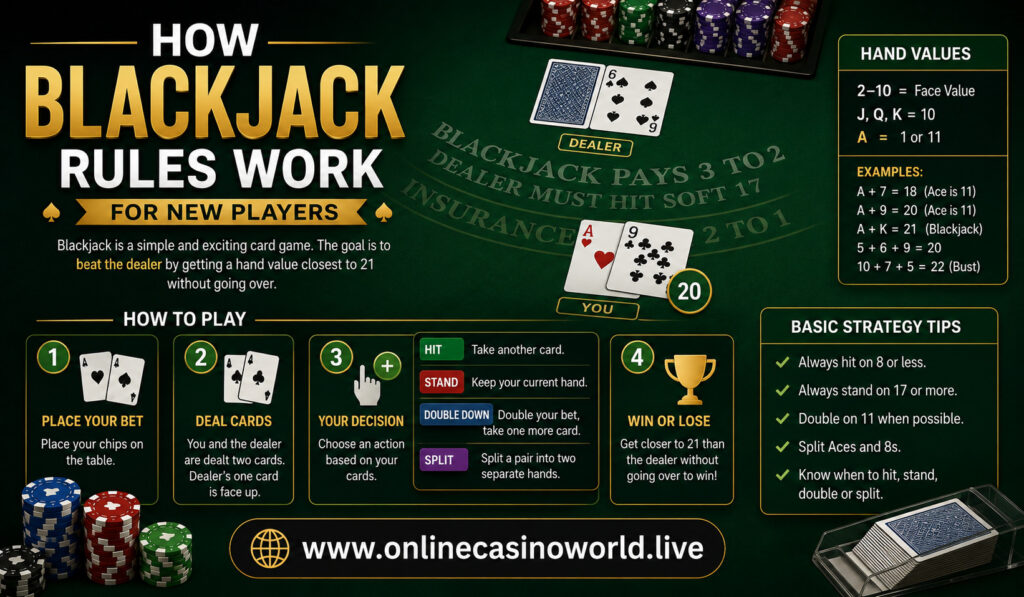
Blackjack is one of the most recognizable card games found in casinos around the world. Although the game can look intimidating to someone seeing it for the first time, the basic rules are relatively simple. The main objective is to build a hand with a value as close to 21 as possible without going over.
Unlike many casino games that depend mainly on matching symbols or numbers, blackjack involves decisions during each round. Players receive cards, calculate their hand value, and decide whether to take another card or stop. The dealer follows a separate set of rules.
For new players, understanding how cards are valued, how a round works, and what terms such as hit, stand, bust, and blackjack mean is the best place to start.
What Is Blackjack?
Blackjack is a card game generally played between individual players and a dealer. The objective is not necessarily to reach exactly 21. Instead, players aim to have a hand that is closer to 21 than the dealer’s hand without exceeding 21.
A standard deck contains cards from 2 through 10, along with face cards and aces. Depending on the particular game, one or more decks may be used.
The game combines chance with player decisions. However, the outcome of any individual hand cannot be guaranteed.
Understanding Blackjack Card Values
Learning card values is the first essential blackjack rule.
Number cards from 2 through 10 are worth their printed value.
For example:
- A 4 is worth 4 points.
- A 7 is worth 7 points.
- A 10 is worth 10 points.
The Jack, Queen, and King are each worth 10 points.
The Ace is different because it can count as either 1 or 11, depending on which value benefits the hand without causing a bust.
For example, an Ace and a 7 can be counted as 8 or 18. In most situations, the hand is treated as 18 because that is the more useful value without exceeding 21.
What Is a Blackjack?
A natural blackjack occurs when a player’s first two cards consist of an Ace and a 10-value card.
For example:
Ace + King = Blackjack
or
Ace + 10 = Blackjack
A blackjack is different from simply having 21 points with three or more cards.
The exact payout and rules for a natural blackjack can vary between blackjack variants and casino tables, so the posted rules should always be checked.
How a Blackjack Round Begins
A typical blackjack round starts when players receive two cards.
The dealer also receives two cards. In many standard versions, one dealer card is placed face up while the other remains face down until the appropriate stage of the round.
Players then make decisions based on their cards and the dealer’s visible card.
Once all players have completed their turns, the dealer reveals the hidden card and plays according to predetermined rules.
This is an important difference between the player and dealer: the dealer generally does not choose freely between all possible actions.
What Does “Hit” Mean?
A hit means asking for another card.
Suppose a player has:
8 + 5 = 13
The player may choose to hit and receive another card.
If the new card is a 4, the hand becomes:
8 + 5 + 4 = 17
The player can then decide whether to take another card or stop, depending on the rules and available choices.
Every additional card changes the total and can potentially bring the hand closer to or further away from 21.
What Does “Stand” Mean?
To stand means to stop taking additional cards.
For example, if a player has 18, they may choose to stand and keep that total.
After standing, the player waits while the dealer completes the dealer’s hand.
Standing does not guarantee a win. The dealer may still produce a stronger hand, or both hands may have the same value.
What Is a Bust?
A bust happens when the value of a hand exceeds 21.
For example:
10 + 8 + 6 = 24
Because 24 is greater than 21, the hand has busted.
A player who busts normally loses the hand immediately, regardless of what the dealer eventually receives.
The Ace can sometimes prevent a bust because it may be counted as 1 instead of 11.
For example:
Ace + 8 + 7
can be counted as 16 rather than 26 because the Ace can have a value of 1.
How the Dealer Plays
The dealer follows predefined rules rather than making decisions based on personal judgment.
A common rule is for the dealer to continue taking cards until reaching at least 17. However, tables can differ in whether the dealer must hit or stand on certain soft 17 hands.
A soft hand is one in which an Ace is currently being counted as 11.
For example:
Ace + 6 = soft 17
The exact dealer rule for this situation should be checked on the table because it can vary between blackjack games.
Comparing the Player and Dealer
Once all players have completed their turns, the dealer finishes their hand.
If the dealer busts, players who have not already busted generally win.
If neither side busts, the hand values are compared.
The higher total wins.
For example:
Player: 19
Dealer: 17
The player has the higher total.
If both have the same value, the result is generally a push, meaning the original wager is returned under standard rules.
What Is a Push?
A push occurs when the player’s final hand and the dealer’s final hand have the same value.
For example:
Player: 18
Dealer: 18
Neither side has a higher total.
Under common blackjack rules, the hand is considered a tie, and the player’s original wager is returned.
Specific rules can vary, so beginners should check the conditions of the particular table.
What Is Doubling Down?
Double down is an optional action available in many blackjack games.
When doubling down, a player increases the original wager and receives one additional card. After receiving that card, the player normally must stand.
The exact conditions for doubling down vary. Some tables allow it on any initial two-card hand, while others restrict it to particular totals.
Because doubling down changes the amount at risk, beginners should understand the table rules before using this option.
What Is Splitting?
A split can be available when the player’s first two cards have the same numerical value under the table’s rules.
For example, two 8s may be split into two separate hands.
The player places an additional wager, and the two cards become the starting cards for separate hands.
Each hand is then played individually.
Splitting rules can differ considerably. Some tables impose restrictions on resplitting, splitting certain pairs, or taking additional cards after a split.
Insurance in Blackjack
Insurance is an optional side wager offered in some situations when the dealer’s visible card is an Ace.
It is separate from the main blackjack hand.
The purpose of insurance is connected to the possibility that the dealer’s hidden card is worth 10, producing a blackjack.
Insurance has its own payout and mathematical characteristics. Beginners should understand that it is not simply another way of playing the main hand.
Blackjack Strategy vs Blackjack Rules
Rules and strategy are two different concepts.
Rules explain how the game operates: card values, dealer actions, hitting, standing, splitting, doubling, and winning conditions.
Strategy involves deciding which action to take in a particular situation.
Learning the rules should come first. Without understanding how the game works, strategy charts or probability discussions can easily become confusing.
It is also important to remember that strategy cannot guarantee a winning result on an individual hand.
Different Blackjack Variations
Not every blackjack game uses exactly the same rules.
Different versions may change:
- The number of decks
- Dealer rules
- Blackjack payouts
- Doubling restrictions
- Splitting rules
- Surrender options
- Side bets
Some tables may also introduce additional variations or special rules.
Therefore, beginners should read the rules displayed at the table before playing. Small rule differences can affect the mathematical characteristics of the game.
Responsible Gambling Matters
Blackjack involves real financial risk when played for money. Winning individual hands does not guarantee a profit over time, and no strategy can remove the risks associated with gambling.
Anyone choosing to gamble should follow applicable laws, set a strict spending limit, and avoid using money needed for essential expenses.
It is also important not to chase losses by increasing wagers simply because previous hands were unsuccessful.
If gambling starts to feel difficult to control, seeking help from a qualified professional or an appropriate gambling-support organization can be an important step.
Final Thoughts
Blackjack rules are easier to understand once the basic card values and player actions are clear. The goal is to build a hand closer to 21 than the dealer without going over.
New players should become familiar with terms such as blackjack, hit, stand, bust, push, double down, split, and insurance. They should also understand that rules can vary between different blackjack tables.
Most importantly, blackjack remains a game involving chance. While players can make decisions during a hand, there is no guaranteed method for predicting the outcome or ensuring a profit.
A solid understanding of the rules helps beginners approach the game with realistic expectations and a clearer understanding of how each round works.