Understanding Slot Volatility and What It Means
Slot volatility is an important concept for anyone trying to understand how modern slot machines work. While terms such as RTP, paylines, jackpots, and bonus features are often discussed, volatility helps explain another part of a slot game’s mathematical design: how its payouts are generally distributed.
For beginners, the word “volatility” can sound complicated. In simple terms, it describes the level of variation in a game’s results. Some games may produce smaller outcomes more frequently, while others may produce larger outcomes less often.
However, volatility does not predict the next spin or guarantee a particular result. It is a statistical characteristic of a game over a large number of plays.
This guide explains what slot volatility means, how low-, medium-, and high-volatility games differ, how volatility relates to RTP, and why previous spins cannot be used to predict future outcomes.
What Is Slot Volatility?
Slot volatility, also known as variance, describes the distribution and frequency of a slot game’s potential outcomes.
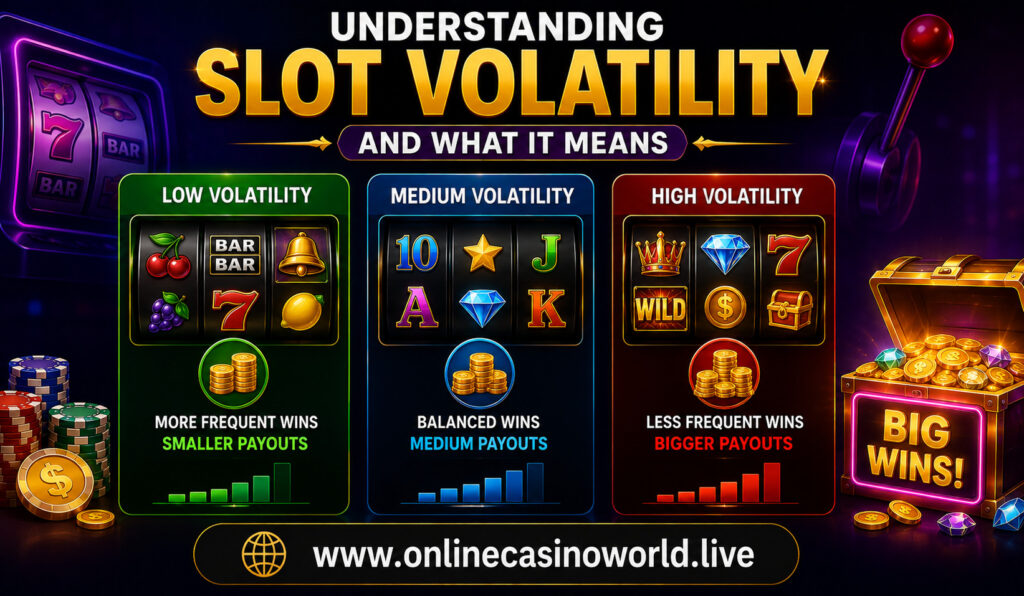
A low-volatility game may be designed around more frequent but generally smaller payouts.
A high-volatility game may produce qualifying payouts less frequently, with a greater portion of its theoretical return coming from larger outcomes.
Medium-volatility games sit somewhere between these broad descriptions.
It is important to remember that volatility does not tell you whether the next spin will win or lose.
Instead, it describes the general behavior of the game’s payout distribution over a large sample.
Why Is Slot Volatility Important?
Volatility provides additional information beyond a game’s advertised RTP.
Imagine two slot games that both have a theoretical RTP of 96%.
They can still feel very different because their payout distributions may not be the same.
One game could produce relatively frequent small payouts, while another could have fewer qualifying payouts but include larger potential outcomes.
Volatility helps explain this difference.
Therefore, RTP and volatility should be viewed as separate characteristics that describe different aspects of a game’s mathematics.
Low-Volatility Slots
Low-volatility slots are generally associated with smaller outcomes occurring more frequently.
A player may see more regular qualifying combinations, but the individual payouts may tend to be modest compared with games designed with higher volatility.
This does not mean that every spin produces a win or that losses cannot occur.
It also does not mean that low volatility produces a profit.
Volatility describes a statistical pattern, not a guarantee.
A low-volatility game can still produce a long sequence of unsuccessful spins.
Medium-Volatility Slots
Medium-volatility slots attempt to occupy a middle ground between lower and higher variance.
Their payout distribution may include a mixture of smaller and larger outcomes.
The exact characteristics vary widely between games.
Because there is no universal mathematical formula that makes every medium-volatility slot behave identically, the label should be treated as a general description rather than an exact prediction.
Different developers and information sources may also use different methods for classifying volatility.
High-Volatility Slots
High-volatility slots are generally associated with less frequent but potentially larger payouts.
This can create greater swings in results.
A player may experience several unsuccessful outcomes before encountering a larger qualifying payout.
However, a high-volatility label does not mean that a large payout is due after a certain number of losses.
The timing of individual outcomes remains uncertain.
High volatility describes the game’s overall distribution rather than a schedule for future results.
How Volatility Differs From RTP
RTP and volatility are often confused, but they describe different things.
RTP is a theoretical long-term percentage describing how much a game is designed to return over a very large number of plays.
Volatility describes how those returns are distributed across different outcomes.
For example, two games might theoretically have the same RTP but different volatility.
One could distribute its expected return across many smaller outcomes.
Another could distribute more of its expected return through fewer, larger outcomes.
Therefore, knowing a game’s RTP alone does not tell you how frequently individual payouts occur.
Volatility Does Not Predict the Next Spin
One of the most important things to understand about slot volatility is that it is not a forecasting tool.
Suppose a high-volatility game has produced several losing spins.
That does not mean a large payout must occur next.
Likewise, a low-volatility game producing several wins does not guarantee that the next spin will also produce a winning combination.
Each outcome is governed by the game’s randomization system and mathematical model.
Volatility describes long-term statistical behavior, not the outcome of an individual spin.
Understanding Random Number Generation
Modern electronic slot machines generally use a Random Number Generator (RNG) or related randomization technology.
The RNG generates values that the game uses to determine outcomes.
The game software then maps those results to the symbols and features displayed to the player.
This means that watching previous results does not provide a reliable way to determine what comes next.
A sequence may look unusual, but random processes can naturally produce streaks, clusters, and gaps.
Can Volatility Change During a Game?
The answer depends on the specific slot.
Some games may have different volatility characteristics during base play and bonus rounds.
A bonus feature may introduce additional multipliers, special symbols, or altered payout distributions.
Certain games may also include mechanics that change the potential outcomes as the game progresses.
Therefore, volatility should be considered in the context of the complete game design.
The paytable and published game information provide the most useful details about a specific title.
Volatility and Jackpot Slots
Progressive jackpot games can have particularly large potential outcomes.
The existence of a jackpot does not automatically define the entire volatility of the game, but a large prize can influence the overall payout distribution.
A progressive jackpot may be awarded relatively infrequently, while smaller outcomes can occur more regularly.
This is another reason why the headline jackpot amount should not be confused with the game’s overall probability structure.
Volatility and Bonus Features
Bonus features can significantly affect a slot game’s payout distribution.
Features such as:
- Free spins
- Multipliers
- Expanding wilds
- Cascading reels
- Re-spins
- Bonus games
can create additional possible outcomes.
Some games may have a substantial portion of their theoretical return associated with bonus rounds.
This can affect how the game’s volatility is experienced.
However, the presence of a bonus feature does not guarantee that it will appear within a particular number of spins.
Can You Choose Volatility?
Players can choose between different games that have different volatility characteristics, where such information is provided.
However, choosing a lower-volatility game does not guarantee smaller losses or more frequent wins.
Likewise, choosing a high-volatility game does not guarantee access to large payouts.
Volatility is simply one characteristic to consider when understanding how a particular game is designed.
It should not be treated as a strategy for guaranteeing a financial outcome.
Volatility vs Variance
The terms volatility and variance are sometimes used interchangeably in discussions about slot machines.
Both refer broadly to the degree of variation in outcomes.
However, different game developers, analysts, and websites may use their own classifications or calculation methods.
This means that labels such as low, medium, and high volatility are not always directly comparable across every game.
For detailed analysis, the game’s mathematical information is more useful than relying only on a label.
How Volatility Affects the Player Experience
Although volatility is a mathematical concept, it can influence how a game feels during a short session.
A lower-volatility game may appear to produce qualifying outcomes more regularly.
A higher-volatility game may involve longer stretches without significant payouts.
These observations are not guarantees. A random sequence can behave very differently from the long-term characteristics of a game.
For example, a high-volatility game can produce a relatively quick large outcome, while a low-volatility game can experience an unusually long losing sequence.
Random variation is always possible.
Why Previous Results Can Be Misleading
People naturally look for patterns in random events.
If a slot produces several small outcomes, someone might assume a large outcome is coming.
If a game has not triggered a bonus feature for a long time, they may think the feature is “due.”
Neither conclusion follows from volatility.
A game’s volatility does not create a countdown toward a particular outcome.
This is closely related to the gambler’s fallacy—the belief that previous independent results make a particular future result more likely.
Volatility and Bankroll Management
When gambling for money, volatility can help explain why some games may produce larger fluctuations in results than others.
A higher-volatility game can potentially create larger swings because its payout distribution may contain fewer but larger outcomes.
This makes it especially important to avoid treating potential large payouts as guaranteed.
Anyone who chooses to gamble should set a clear spending limit and avoid using money required for essential expenses.
Common Misconceptions About Slot Volatility
“High volatility means bigger wins are guaranteed.”
No. High volatility describes the distribution of potential outcomes, not a guarantee that a large payout will occur.
“A high-volatility slot is due after a losing streak.”
No. Previous spins do not create a requirement for a future outcome.
“Low volatility means you cannot lose much.”
Not necessarily. Low volatility does not eliminate losses.
“RTP and volatility mean the same thing.”
They do not. RTP describes theoretical long-term return, while volatility describes the distribution of outcomes.
“More bonus features always mean higher volatility.”
Not necessarily. Bonus mechanics are only one part of a game’s overall mathematical design.
How to Find a Slot’s Volatility
Not every game displays a simple volatility rating.
Depending on the game, information may be available through the paytable, game rules, technical information, or the developer’s documentation.
If volatility is not explicitly stated, it should not be guessed simply from the game’s appearance or jackpot size.
Terms such as “high volatility” should also be interpreted carefully because classification methods can vary.
Responsible Gambling Considerations
Understanding volatility does not remove the financial risks associated with gambling.
A high-volatility game can produce substantial fluctuations, while a low-volatility game can still result in losses.
Anyone who chooses to gamble should understand the risks, follow applicable laws, establish a firm budget, and avoid chasing losses.
It is also important to remember that gambling outcomes are uncertain and that a slot machine should not be treated as a reliable source of income.
If gambling becomes difficult to control, seeking support from a qualified professional or appropriate gambling-support organization may be helpful.
Final Thoughts
Slot volatility is a way of describing how a game’s potential outcomes are distributed.
Low-volatility slots are generally associated with more frequent, smaller outcomes, while high-volatility slots tend to involve less frequent but potentially larger outcomes. Medium-volatility slots fall between these broad categories.
However, volatility is not a prediction tool. It cannot tell you when a win, bonus, or jackpot will appear.
RTP and volatility also provide different types of information. RTP describes theoretical long-term return, while volatility describes the variation and distribution of outcomes.
For beginners, understanding these concepts can make slot-machine information easier to interpret. Most importantly, neither volatility nor any other game statistic can guarantee a winning result. Individual spins remain uncertain, and previous outcomes cannot reliably predict future ones.