House Edge Explained Across Popular Casino Games
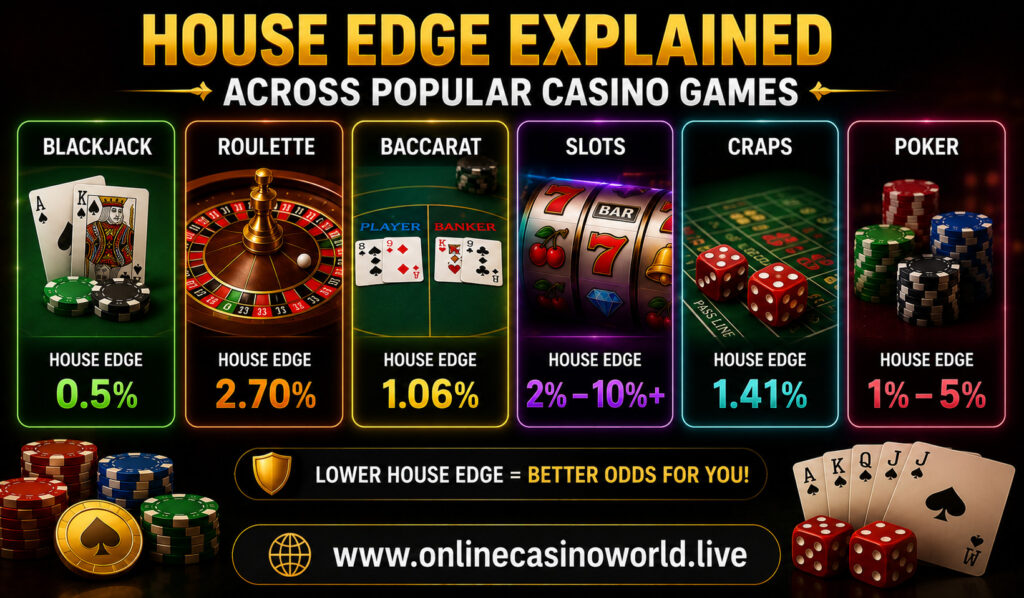
The term house edge appears frequently when people discuss casino games, but it can be confusing for beginners. What does it actually mean? Does a higher house edge always mean you will lose? And how does the house edge differ between games such as roulette, blackjack, baccarat, and slot machines?
Understanding the house edge is one of the simplest ways to understand the mathematics behind casino games. It represents the casino’s theoretical advantage over players over a large number of bets. It does not predict what will happen during one session or on the next spin, roll, or hand.
This beginner’s guide explains what house edge means and how it compares across popular casino games.
What Is House Edge?
The house edge is the mathematical advantage a casino has over players in a particular game or wager.
It is usually expressed as a percentage.
For example, if a game has a theoretical house edge of 5%, the mathematical expectation is that the casino retains about ₹5 for every ₹100 wagered over a very large number of bets.
This does not mean a player automatically loses ₹5 every time they wager ₹100. Individual results can be very different because gambling outcomes involve randomness.
A player may win substantially during a short session, while another player may lose more than the theoretical percentage.
The house edge becomes meaningful when considering a very large number of wagers.
House Edge vs RTP
House edge and Return to Player (RTP) are closely connected.
RTP describes the theoretical percentage returned to players, while house edge describes the theoretical percentage retained by the casino.
For a simple game:
RTP + House Edge = 100%
For example, a game with a theoretical RTP of 96% has a corresponding house edge of approximately 4%.
These figures describe long-term mathematical expectations rather than guaranteed individual results.
House Edge in Roulette
Roulette is one of the easiest games for demonstrating how house edge works.
The two most common wheel formats are European Roulette and American Roulette.
European Roulette has a single zero, while American Roulette has both zero and double zero.
The additional zero changes the mathematical probabilities.
For many standard wagers, European Roulette has a house edge of approximately 2.70%.
American Roulette has a house edge of approximately 5.26%.
That difference may appear small, but over a large number of wagers it can become mathematically significant.
This is why the wheel configuration is an important factor when comparing roulette games.
House Edge in Blackjack
Blackjack is different from roulette because the player’s decisions can affect the mathematical outcome.
Players can choose actions such as hitting, standing, doubling down, and splitting, depending on the table’s rules.
When appropriate basic strategy is followed, some blackjack games can have a relatively low theoretical house edge compared with many other casino games.
However, there is no single house-edge figure that applies to every blackjack table.
The result can depend on factors such as the number of decks, dealer rules, blackjack payout, doubling restrictions, splitting rules, and other conditions.
Player decisions also matter.
Playing without understanding basic strategy can increase the effective house advantage.
Therefore, blackjack’s house edge should always be considered alongside the exact table rules and playing decisions.
House Edge in Baccarat
Baccarat has several different betting options, and each can have a different mathematical advantage.
The most commonly discussed wagers are the Banker, Player, and Tie bets.
The Banker bet generally has a relatively low house edge under standard baccarat rules, although a commission is commonly charged on winning Banker wagers.
The Player bet has a slightly higher mathematical disadvantage.
The Tie bet typically has a substantially higher house edge than the main Banker and Player wagers.
This demonstrates an important principle: the house edge is often associated with the specific wager, not simply the name of the game.
Two bets within the same game can have very different mathematical characteristics.
House Edge in Slot Machines
Slot machines can have widely varying house edges.
Unlike roulette, where the wheel structure makes the basic mathematical advantage relatively easy to calculate, slot-machine mathematics can be much more complex.
A slot’s theoretical house edge is closely related to its RTP.
For example, a slot with a theoretical RTP of 96% has a theoretical house edge of approximately 4%.
However, slot games can differ considerably in their RTP, volatility, payout structures, bonus features, and jackpot mechanics.
A slot’s advertised jackpot does not automatically indicate its house edge.
Players should look at the specific game’s published information rather than assuming that all slots have the same mathematical return.
House Edge in Craps
Craps contains numerous betting options, which makes its house-edge structure more complicated.
Some bets can have relatively low mathematical house advantages, while others can have considerably higher ones.
The Pass Line and Don’t Pass bets are commonly discussed because they have relatively modest house edges under standard rules.
Other proposition-style wagers can have much higher mathematical disadvantages.
This makes craps a good example of why the exact bet matters more than simply knowing the name of the casino game.
House Edge in Casino War
Casino War is a simple card game based loosely on the traditional children’s card game War.
The player and dealer receive cards, and the higher card wins.
Although the basic rules are easy to understand, the mathematical advantage can be less favorable than in some other popular casino games.
Some versions also include a War option when the initial cards tie.
That additional wager has its own mathematical characteristics.
As with baccarat and craps, players should examine the individual betting options rather than assuming that every wager carries the same house edge.
House Edge in Three Card Poker
Three Card Poker combines elements of poker with casino-style wagering.
The game commonly includes an Ante bet and may offer additional wagers such as Pair Plus.
The house edge can differ depending on the specific wager and the rules being used.
The Ante game also involves player decisions, while some side bets are based entirely on the player’s hand.
This makes Three Card Poker another example where the house advantage can vary considerably between different betting options.
Why House Edge Is Different Across Games
Several factors influence the house edge.
One of the biggest is the game’s rules.
A small rule change can alter probabilities and therefore change the casino’s mathematical advantage.
Other factors include the payout structure, available wagers, number of cards or decks, wheel configuration, and player decisions.
In games such as blackjack, player strategy can have a meaningful impact on the mathematical expectation.
In games based primarily on random outcomes, such as many slot machines, players generally have much less influence over the result.
Does a Low House Edge Mean You Will Win?
No.
A low house edge does not guarantee a winning session.
Suppose a game has a theoretical house edge of 2%.
That does not mean a player who wagers ₹1,000 will necessarily lose only ₹20.
They could win ₹500, lose ₹500, or experience another result entirely.
The house edge represents a long-term mathematical expectation across a sufficiently large number of wagers.
Short-term results can vary significantly.
Can the House Edge Change?
Yes.
The mathematical advantage can change when the rules change.
For example, different blackjack tables can have different dealer rules and blackjack payouts.
Roulette can have different wheel layouts.
Baccarat can have different commission structures.
Slot machines can have different RTP configurations.
Therefore, it is not enough to know that a particular game has a certain average house edge. The exact version and wager should be checked.
Why Previous Results Do Not Change the House Edge
A common misconception is that a game becomes more likely to produce a player-friendly outcome after a long losing streak.
This is not how house edge works.
If a roulette wheel has a particular mathematical structure, previous spins do not change the underlying probabilities of the next spin.
Similarly, a slot machine that has not produced a major payout recently is not automatically required to produce one.
Random outcomes can create streaks and unusual sequences naturally.
The house edge remains a mathematical characteristic of the game.
House Edge and Responsible Gambling
Understanding house edge can help people make more informed decisions about casino games, but it does not eliminate gambling risk.
Even a game with a relatively low theoretical house edge can produce significant losses over a short period.
Anyone who chooses to gamble should set a firm budget, avoid chasing losses, and never use money intended for essential expenses.
It is also important to understand the rules and applicable gambling laws before participating.
Casino games should be treated as entertainment rather than as a dependable way to make money.
Final Thoughts
The house edge represents the casino’s theoretical mathematical advantage over players over a large number of wagers. It is one of the most useful concepts for understanding why casino games are profitable for operators over the long term.
The exact house edge varies significantly between games and even between individual wagers.
European Roulette is generally associated with a lower house edge than American Roulette because it has one zero instead of two. Blackjack can offer relatively favorable mathematical conditions when the rules are favorable and basic strategy is used correctly. Baccarat has different house edges for Banker, Player, and Tie bets, while slot machines can vary widely depending on their RTP and game design.
The key lesson is simple: house edge is a long-term mathematical concept, not a prediction of an individual result. A lower house edge may mean a smaller theoretical disadvantage, but it never guarantees a win.
Understanding the specific rules, payouts, RTP, and house edge of a game provides a clearer picture of its mathematics and helps beginners approach casino gaming with more realistic expectations.