Casino Game Terminology Every Beginner Should Know
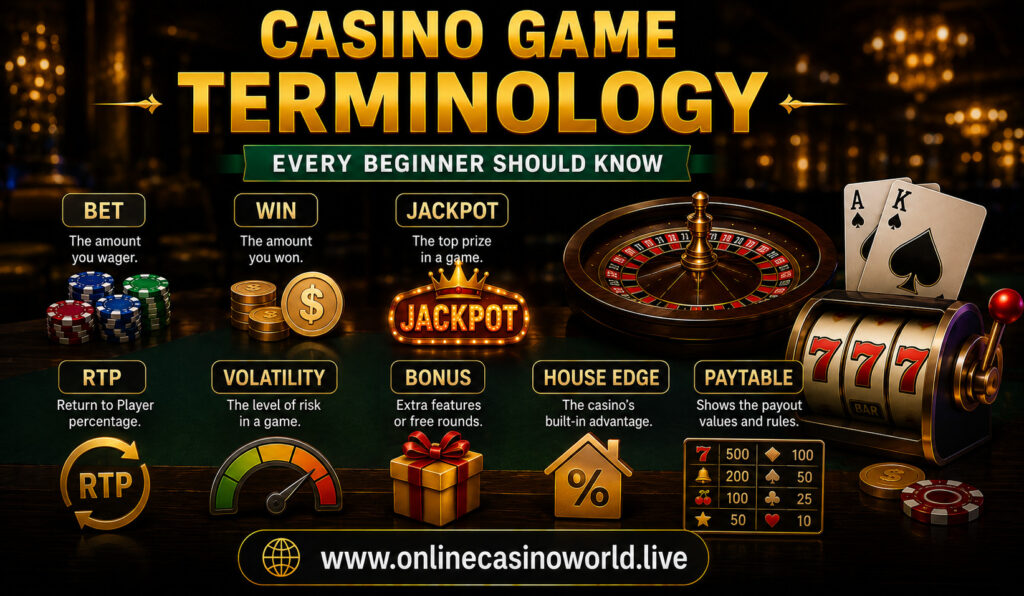
Walking into an online or traditional casino for the first time can feel overwhelming, especially when you encounter unfamiliar terms. Words such as RTP, house edge, bankroll, volatility, paytable, and progressive jackpot are commonly used in casino gaming, but beginners may not immediately understand what they mean.
Learning basic casino game terminology makes it easier to understand game rules, compare different options, and make informed decisions. Whether you are interested in slots, blackjack, roulette, baccarat, or live dealer games, knowing the language of casino gaming is a useful first step.
This guide explains some of the most common casino terms in simple language.
1. House Edge
The house edge is the mathematical advantage a casino has over players in a particular game.
It is usually expressed as a percentage and represents the casino’s theoretical long-term advantage.
For example, if a game has a theoretical house edge of 4%, it means the casino is mathematically expected to retain about ₹4 for every ₹100 wagered over a very large number of bets.
This does not mean a player will lose exactly 4% every time. Short-term results can vary considerably.
2. RTP
RTP, or Return to Player, is another important casino term, especially for slot games.
It represents the theoretical percentage of wagers a game is designed to return to players over a very large number of plays.
For example, a slot with a theoretical RTP of 96% is designed to return ₹96 for every ₹100 wagered over a sufficiently large sample.
RTP does not predict the result of an individual spin or guarantee that a player will receive a particular amount back.
3. Volatility
Volatility describes how frequently a game tends to produce wins and how large or small those wins may be.
Low-volatility games may produce smaller wins more frequently, while high-volatility games may produce larger wins less often.
Medium-volatility games fall somewhere between these two broad categories.
Volatility is particularly important when comparing slot games because two slots can have similar RTPs but very different patterns of payouts.
4. Paytable
A paytable explains how a casino game pays.
In a slot game, the paytable may show the value of different symbols, winning combinations, bonus features, wilds, scatters, and other mechanics.
In other casino games, similar information may be provided through the game’s rules or payout information.
Beginners should always check the paytable before playing an unfamiliar game.
5. Bankroll
A player’s bankroll is the amount of money they have set aside for gambling.
For responsible play, a bankroll should come from money that the player can afford to lose rather than funds needed for essential expenses.
Having a predetermined limit can help prevent impulsive spending.
A bankroll should not be confused with income or savings that are needed for everyday financial responsibilities.
6. Bet
A bet is the amount of money a player wagers on a particular outcome or game round.
Different games use different betting structures.
In roulette, players can bet on individual numbers, colors, or groups of numbers. In blackjack, a player generally places an initial wager before receiving cards.
Slot games typically allow players to select their wager before each spin.
7. Stake
Stake is another common term for the amount being wagered.
Depending on the casino or game, “stake,” “bet,” or “wager” may be used interchangeably.
Understanding the stake is important because the size of each wager directly affects how quickly a gambling budget can be used.
8. Wagering
Wagering refers to the act of placing bets.
You may also encounter the term in casino promotions, where a “wagering requirement” can describe how many times a qualifying amount must be wagered before certain promotional funds can be withdrawn.
These terms can vary between operators, so promotional conditions should always be read carefully.
9. Win
A win occurs when the result of a game qualifies for a payout according to its rules.
The size of the payout depends on the game, wager, and winning combination.
A win does not necessarily mean a player has made an overall profit. For example, someone could win one round but still lose money across an entire session.
10. Loss
A loss occurs when a wager does not produce a qualifying payout.
Casino games can involve a combination of wins and losses during a session. Because outcomes are uncertain, a series of losses can happen even when a game has a published RTP.
Players should avoid chasing losses by increasing their wagers simply because they have recently lost.
11. Payline
A payline is a specific pattern through a slot’s reels that can produce a winning combination.
Traditional slots may have only a few paylines, while modern online slots can feature numerous ways to win.
Some newer games do not use conventional paylines at all. Instead, they may use systems based on adjacent symbols, clusters, or other mechanics.
12. Wild Symbol
A wild symbol is a special slot symbol that can substitute for certain other symbols to help create winning combinations.
The exact function of a wild depends on the game’s rules.
Some wilds may simply substitute for regular symbols, while others can expand, move, multiply wins, or trigger special features.
The paytable normally explains how the wild works.
13. Scatter Symbol
A scatter symbol is another common slot feature.
Unlike regular symbols, scatters may not need to appear on a specific payline to provide a reward. Depending on the game, a certain number of scatters can trigger free spins, bonus rounds, or other features.
The exact requirements differ between games.
14. Bonus Round
A bonus round is a special game feature that operates differently from the standard gameplay.
In slots, bonus rounds may involve picking objects, spinning a separate wheel, collecting symbols, or playing a short secondary game.
Bonus rounds can add variety and potentially provide additional rewards, but their rules and probabilities differ from one game to another.
15. Free Spins
Free spins are spins in a slot game that do not require the player to place a new standard wager for each spin.
They may be awarded through a bonus feature, promotion, or qualifying symbol combination.
Even when spins are described as “free,” any associated promotional conditions should be checked carefully.
16. Jackpot
A jackpot is a particularly large prize available in certain casino games.
Some games have fixed jackpots, while others have progressive jackpots.
A jackpot is not guaranteed to be won within a particular period. The probability of hitting one depends on the game’s design and rules.
17. Progressive Jackpot
A progressive jackpot can increase over time as qualifying wagers contribute to the prize pool.
The jackpot may continue growing until a player triggers the qualifying winning combination.
Progressive jackpots can become very large, but their major prizes are generally difficult to hit. Players should not increase spending simply because a progressive jackpot has reached an attractive amount.
18. RNG
RNG stands for Random Number Generator.
RNG technology is commonly used in automated online casino games to produce game outcomes.
For example, an RNG can determine which symbols appear on a slot’s reels or which number appears in an automated roulette game.
The purpose is to produce outcomes that are unpredictable and follow the mathematical design of the game.
19. Live Dealer
A live dealer game is an online casino game hosted by a real human dealer.
Games such as blackjack, roulette, and baccarat can be offered in live dealer formats.
The dealer operates physical casino equipment while cameras broadcast the action to online players.
This format is designed to provide a more realistic and interactive casino experience.
20. Push
A push is a tie between the player and dealer in certain casino games, particularly blackjack.
For example, if both the player and dealer have qualifying hands with the same value, the round may end in a push.
In many blackjack games, the original wager is returned rather than being treated as a win or loss.
The exact treatment depends on the game’s rules.
21. Bust
In blackjack, a bust occurs when a hand’s value exceeds 21.
A player who goes over 21 normally loses the hand immediately, regardless of the dealer’s eventual total.
Because an ace can count as either 1 or 11, its value can change depending on the other cards in the hand.
22. Hit
A hit is a blackjack decision to request another card.
Players can generally continue hitting until they choose to stand or their hand exceeds 21.
The option is one of the fundamental decisions in blackjack.
23. Stand
To stand means to keep the current blackjack hand and take no additional cards.
The dealer then completes the hand according to the table’s rules.
Choosing whether to hit or stand is one of the main strategic decisions in blackjack.
24. Split
A split is a blackjack option that may be available when a player’s initial cards form a qualifying pair.
The pair is separated into two individual hands, and an additional wager is generally required.
The exact conditions for splitting vary between blackjack tables.
25. Double Down
Double down is a blackjack action where the player doubles the original wager in exchange for receiving an additional card, subject to the table’s rules.
It can be a useful strategic option in certain situations, but players should understand the specific restrictions before using it.
26. Inside and Outside Bets
These terms are commonly associated with roulette.
Inside bets are placed on specific numbers or smaller combinations located within the central number grid.
Outside bets cover broader groups, such as red or black, odd or even, or groups of numbers.
These bets have different payout levels and probabilities.
27. Straight-Up Bet
A straight-up bet in roulette is a wager placed on a single number.
Because only one number must appear for the bet to win, its payout is much larger than many broader roulette bets.
However, the probability of winning is also lower.
28. Dealer
The dealer is the person who operates and manages a casino table game.
In blackjack, the dealer deals cards and follows the table’s rules. In roulette, the dealer operates the wheel and manages bets.
In online live dealer games, the dealer performs these functions while players participate remotely.
29. Table Limit
A table limit refers to the minimum and maximum amount a player can wager at a particular table.
For example, a blackjack table may have a minimum bet and a maximum bet determined by the casino.
Players should check these limits before joining a table to make sure they match their intended budget.
30. House
The house is the casino or gambling operator offering the game.
When someone says that “the house has an edge,” they are referring to the mathematical advantage built into the casino’s games.
The house edge allows the casino to remain profitable over a large number of wagers, although individual players can still win or lose in the short term.
Why Casino Terminology Matters
Understanding casino vocabulary is more than a matter of learning definitions. These terms can directly affect how players interpret game rules, payouts, probabilities, and promotional conditions.
For example, confusing RTP with a guaranteed return can create unrealistic expectations. Similarly, not understanding volatility can make a slot game feel very different from what a beginner expected.
Reading the paytable, checking the rules, and understanding the betting limits before playing can help avoid unnecessary confusion.
Responsible Gambling Should Come First
Knowing casino terminology does not eliminate financial risk.
Every casino game has some level of uncertainty, and many games are designed with a mathematical advantage for the house. Strategy may influence decisions in certain games, but it cannot guarantee a profit.
Players should set a clear entertainment budget, avoid chasing losses, and never gamble with money needed for essential expenses.
It is also important to use legal and appropriately licensed gambling services where available.
Final Thoughts
Casino terminology can seem complicated at first, but learning the most common terms makes casino games much easier to understand. Concepts such as house edge, RTP, volatility, bankroll, paytable, RNG, jackpot, and live dealer provide useful context when comparing games.
For card games, terms such as hit, stand, split, double down, bust, and push explain the basic actions and outcomes. For slots and roulette, understanding paylines, wilds, scatters, inside bets, and outside bets can make the rules clearer.
The more familiar beginners become with casino language, the easier it is to understand what a game offers and what its risks are. Most importantly, knowledge should be combined with responsible play, realistic expectations, and a clear spending limit.