Table Games vs Slot Games: How They Differ
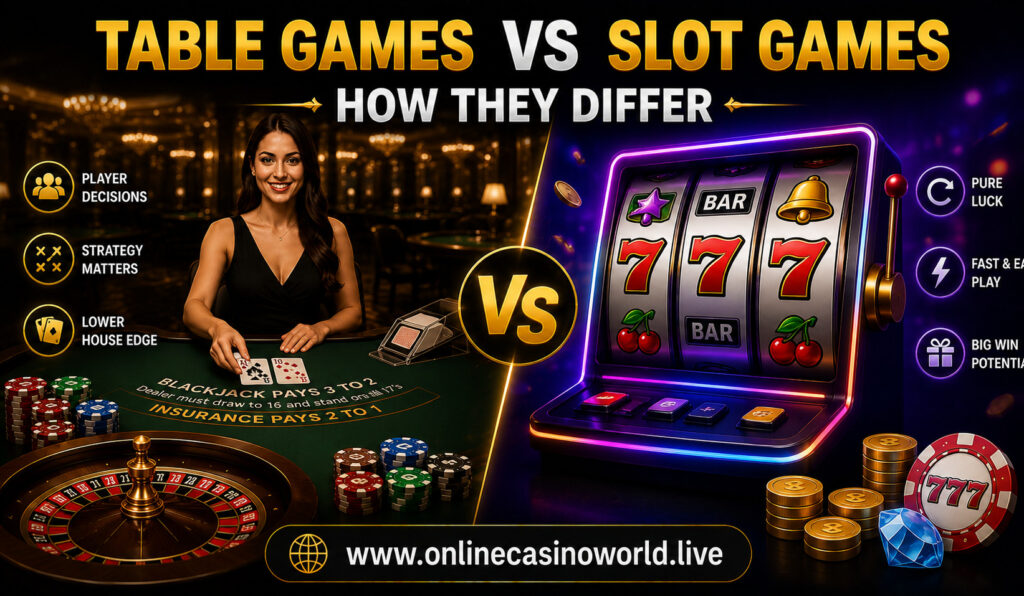
Casino gaming offers a wide range of choices, but two categories stand out: table games and slot games. From roulette and blackjack to colorful digital reels, these games attract players for very different reasons.
Although both involve wagering money on uncertain outcomes, the way they are played can vary significantly. Table games often involve cards, dice, or wheels and may require players to make decisions during a round. Slot games, on the other hand, generally focus on quick, automated gameplay where players select their wager and activate the game.
Understanding the differences between table games and slot games can help beginners decide which type of casino experience better matches their preferences.
What Are Table Games?
Table games are traditional casino games played on dedicated gaming tables. Common examples include blackjack, roulette, baccarat, and craps.
Depending on the game, players may compete against the casino, predict an outcome, or make decisions that influence how a round develops.
For example, blackjack involves choosing actions such as hitting or standing, while roulette requires players to select where they want to place their bets before the wheel is spun.
Table games can be played in physical casinos or online. Online versions may be automated or hosted by a live dealer.
One defining characteristic of table games is that they usually have clearly established rules and betting areas that players interact with throughout the round.
What Are Slot Games?
Slot games are casino games built around reels, symbols, and winning combinations.
A traditional slot machine might have three mechanical reels, while modern online slots can feature five or more reels, multiple paylines, bonus features, and advanced graphics.
Players generally choose their wager and start the game. The software then determines the outcome according to the game’s programmed mechanics.
Modern slots can have almost any theme, from adventure and mythology to movies, fantasy, sports, and popular culture.
Their straightforward controls make them particularly accessible to beginners.
The Biggest Difference: Player Interaction
One of the clearest differences between table games and slots is how much interaction takes place during a round.
Many table games require players to make decisions. In blackjack, for example, the player decides whether to hit, stand, split, or double down, depending on the situation and table rules.
Roulette provides fewer strategic decisions, but players still choose which bets to place.
Slots generally require much less decision-making once the wager has been selected. Players can often choose the stake, activate the reels, and wait for the result.
This makes slots appealing to people who prefer simple and automated gameplay.
Table Games Often Feel More Social
Traditional table games can provide a stronger social atmosphere, especially in physical casinos.
Players may sit around the same blackjack or baccarat table, interact with a dealer, and watch other participants play.
Live dealer versions of table games can bring some of this experience to online platforms. Players can watch a real dealer operate the table and may be able to communicate through a chat feature.
Slots are usually more individual. Even when players are in a physical casino surrounded by other people, they generally interact with their own machine rather than a shared table.
Speed of Gameplay
Slots generally offer faster gameplay.
A player can often start a new spin immediately after the previous result. Online slots can process outcomes within seconds, allowing players to move quickly from one round to another.
Table games tend to follow a more structured pace.
A blackjack dealer must deal cards and resolve each hand. A roulette dealer needs to accept bets, spin the wheel, and announce the result. Craps involves multiple stages and dice rolls.
This difference means slots can suit players who prefer fast-paced entertainment, while table games may appeal to those who enjoy watching each round develop.
Strategy and Skill
Another major difference is the role of strategy.
Some table games provide meaningful decisions that can influence the mathematical outcome of a player’s choices. Blackjack is a strong example. Basic strategy can help players choose statistically better actions in different situations.
Poker can involve an even greater strategic element, depending on the format.
Roulette and baccarat, however, offer much less control over the final outcome.
Slots are generally much more dependent on chance. Players can choose their wager and sometimes select specific features or paylines, but they cannot control the underlying result of an individual spin.
It is important to remember that strategy does not guarantee profit. Even in games where decision-making matters, the casino may retain a mathematical advantage.
How the House Edge Differs
Both table games and slots can have a house edge, but the mathematical advantage varies considerably.
Table games can have different house edges depending on the specific game and rules. Blackjack, for example, can have relatively favorable mathematical conditions under certain rule sets when players use appropriate basic strategy.
Roulette has a house edge determined largely by the wheel configuration. European roulette generally has a lower house edge than American roulette because it has one zero rather than two.
Slot games have their own mathematical models. Their theoretical return to player (RTP), volatility, and hit frequency can vary from one title to another.
Players should therefore examine the individual game rather than assuming one entire category is always better.
Variety of Themes and Features
Slots generally offer much more variety in terms of themes and visual features.
A single online casino can provide hundreds or even thousands of slot titles with different graphics, soundtracks, bonus mechanics, and storylines.
Features may include wild symbols, scatters, free spins, multipliers, expanding reels, bonus rounds, and progressive jackpots.
Table games tend to have more consistent designs because their fundamental rules have remained relatively stable over time.
However, casinos can still offer numerous table variations with different rules, betting limits, and presentation styles.
Betting Flexibility
Slot games often provide a broad range of betting options.
Players may be able to adjust their stake per spin, choose the number of paylines in certain games, or select different coin values.
Table games can have fixed minimum and maximum betting limits based on the table.
Online casinos may offer several tables for the same game with different limits, but players still need to check the individual table before playing.
For beginners with a limited entertainment budget, understanding the minimum bet can be particularly important.
Live Table Games vs Automated Slots
Technology has created a clear distinction between live table games and slots.
Live blackjack, roulette, and baccarat use real dealers and physical casino equipment. Cameras stream the action to online players, who place their bets through a digital interface.
Slots are almost always automated. Their reels, symbols, bonus features, and outcomes are controlled by casino software.
This means live table games can provide a more immersive and social experience, while slots generally emphasize convenience and speed.
Convenience and Accessibility
Slots tend to be extremely convenient.
They are available across computers, smartphones, and tablets on many online platforms, and players can often start a game with just a few clicks.
Automated table games can also be highly accessible, but live dealer tables may have additional requirements because they depend on streaming video and available tables.
A stable internet connection is particularly useful for live games.
Players should also consider the legal availability of online gambling services in their location before participating.
Which Is Better for Beginners?
There is no universal answer.
Slots can be easier for someone who wants a simple experience with minimal rules. A player can understand the basic controls quickly and explore different themes and features.
Table games may be more suitable for someone who enjoys learning rules and making decisions.
For example, a person interested in strategy may enjoy learning blackjack basics, while someone who prefers straightforward gameplay may find slots more appealing.
Beginners can also learn about games through free-play versions where available before deciding whether to participate with real money.
Risk and Responsible Play
Both categories involve financial risk.
The simplicity of slots can sometimes make it easy to play many rounds quickly, which means spending can add up faster than expected. Table games may feel slower, but losses can still accumulate depending on the size and frequency of wagers.
Players should establish a budget before starting and avoid increasing bets to recover previous losses.
Gambling should not be treated as a guaranteed income source. Even games that involve strategy remain subject to probability and financial risk.
Using responsible gambling tools, such as deposit limits or session limits where available, can help players maintain control.
Table Games vs Slot Games: Key Differences at a Glance
The two categories can be summarized through their overall playing styles.
Table games generally offer:
- More player interaction
- Traditional casino gameplay
- Greater emphasis on rules and decisions
- Live dealer options
- Shared table experiences
- Different betting structures
Slot games generally offer:
- Simple controls
- Fast rounds
- Large numbers of themes
- Automated gameplay
- Numerous bonus features
- Flexible digital formats
These are general differences, and individual games can vary significantly.
Final Thoughts
Table games and slot games provide two very different ways to experience casino gaming. Table games such as blackjack, roulette, baccarat, and craps often involve more interaction and, in some cases, strategic decision-making.
Slots are generally simpler and faster, with a huge range of themes, features, and digital designs.
Choosing between them ultimately depends on what a player enjoys. Those who like decisions, traditional casino rules, and live interaction may prefer table games. Those who want quick, easy-to-understand gameplay and extensive visual variety may prefer slots.
Regardless of the choice, understanding the rules, checking the game’s mathematical characteristics, setting a budget, and playing responsibly are more important than choosing one category over another.