Blackjack Hand Rankings and Basic Rules Explained
Blackjack is one of the most popular casino card games, but beginners often have questions about hand values, winning combinations, and the rules that determine the outcome of each round. Unlike poker, blackjack does not use a complicated ranking system where one hand always beats another. Instead, the main objective is to build a hand with a value as close to 21 as possible without going over.
Understanding blackjack hand values and basic rules makes the game much easier to follow. Whether you are playing at a traditional casino, an online casino, or a live dealer table, the fundamental principles remain similar, although specific rules can vary.
This guide explains blackjack hand rankings, card values, player actions, dealer rules, and other basics beginners should know.
What Is Blackjack?
Blackjack is a card game played between players and a dealer. The goal is to finish with a hand value higher than the dealer’s hand without exceeding 21.
Players are not normally competing directly against each other. Instead, each player compares their final hand with the dealer.
A round begins when players place their bets. The dealer then deals cards according to the table’s rules.
Players make decisions based on their cards and the dealer’s visible card. Once all players have completed their hands, the dealer plays according to predetermined rules.
The winning outcome depends on the final hand values.
Understanding Blackjack Card Values
The first step in learning blackjack is knowing how the cards are counted.
Number cards: 2 through 10 are worth their face value.
Face cards: Jack, Queen, and King are each worth 10.
Ace: An ace can be worth either 1 or 11, depending on which value is more useful without causing the hand to exceed 21.
For example, a hand containing an Ace and a 6 can have a value of 17 if the Ace counts as 11.
If counting the Ace as 11 would cause the hand to exceed 21, it can instead count as 1.
This flexible value is one of the most important features of blackjack.
What Is the Best Blackjack Hand?
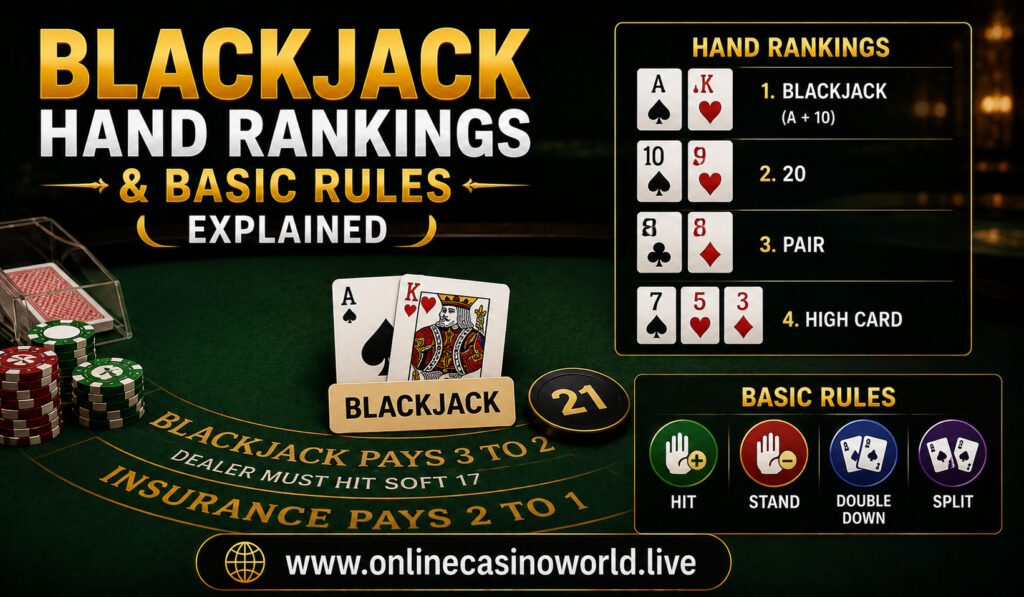
The strongest standard starting hand is a natural blackjack.
A natural blackjack consists of an Ace and a 10-value card, such as a 10, Jack, Queen, or King.
For example:
Ace + King = Blackjack
The hand has a value of 21 using only two cards.
A natural blackjack is different from reaching 21 with three or more cards. The payout for a natural blackjack depends on the rules of the particular table.
Some tables use a 3:2 payout, while others may use different payout rules.
Players should always check the table rules before playing.
Other Strong Blackjack Hands
After a natural blackjack, there is no traditional ranking system like the one used in poker.
Instead, hands are compared primarily by their total value.
For example, a hand totaling 20 beats a hand totaling 19.
A hand totaling 19 beats a hand totaling 18.
A hand totaling 21 with three or more cards can beat lower totals, but it does not necessarily receive the same treatment as a natural blackjack.
This distinction is important for beginners.
What Is a Hard Hand?
A hard hand is a blackjack hand that either contains no Ace or contains an Ace that must count as 1 to prevent the hand from going over 21.
For example:
10 + 7 = Hard 17
Another example is:
Ace + 9 + 5 = Hard 15
In the second example, counting the Ace as 11 would produce 25, so the Ace must count as 1.
Hard hands can require careful decisions because taking another card may increase the risk of busting.
What Is a Soft Hand?
A soft hand contains an Ace that can still count as 11 without the hand exceeding 21.
For example:
Ace + 6 = Soft 17
Here, the Ace counts as 11 and the 6 counts as 6, giving a total of 17.
Soft hands are important because the flexible Ace gives the player additional protection against busting.
If another card makes the total too high while the Ace is valued at 11, the Ace can usually switch to a value of 1.
What Does Bust Mean?
A bust occurs when a hand’s total exceeds 21.
For example:
10 + 8 + 6 = 24
This hand has busted.
When a player busts, they normally lose the hand immediately, regardless of what the dealer eventually receives.
Because of this, deciding whether to take another card is one of the central decisions in blackjack.
What Does Push Mean?
A push occurs when the player and dealer finish with the same qualifying hand value.
For example, if the player has 19 and the dealer also has 19, the round may result in a push.
In a standard push, the player’s original wager is returned.
The exact rules can vary, but a push generally means neither side wins the wager.
The Basic Blackjack Round
A typical blackjack round follows a simple sequence.
First, players place their wagers. The dealer then deals two cards to each player and two cards to themselves.
Usually, the player’s cards are visible while the dealer has one visible card and one hidden card, depending on the table’s dealing procedure.
Players then make their decisions one at a time.
Once all players have completed their hands, the dealer reveals the hidden card and follows the table’s predetermined rules.
Finally, the dealer’s hand is compared with each remaining player’s hand.
Hit
A hit means asking for another card.
For example, if a player has 12 and believes another card could improve the hand, they may choose to hit.
The player can generally continue requesting cards until they stand, bust, or reach a condition where no further card is permitted.
The decision to hit depends on the player’s hand, dealer’s visible card, and the rules of the table.
Stand
To stand means keeping the current hand and taking no additional cards.
For example, a player holding a strong total may decide that taking another card carries too much risk.
Once a player stands, their hand is finished for that round.
The dealer then completes the game according to the table rules.
Double Down
Double down is an option that allows a player to double their original wager and receive one additional card.
The player must then stand after receiving that card under standard double-down rules.
The availability and restrictions of doubling down can vary between tables.
Because the wager increases, players should understand the conditions before using this option.
Split
A split may be available when a player’s first two cards form a qualifying pair.
The pair is separated into two individual hands, and the player normally places an additional wager equal to the original bet.
For example, if a player receives two 8s, they may be able to split them into two separate hands.
Each new hand receives another card, and the player plays them separately.
Split rules vary considerably, so beginners should check the table conditions.
Surrender
Some blackjack tables offer a surrender option.
When available, surrender allows the player to give up the hand after the initial deal in exchange for receiving part of the original wager back.
There are different types of surrender rules, and not every blackjack game offers this feature.
Because surrender can affect the mathematical value of certain hands, players should understand exactly when the option is available.
The Dealer’s Rules
One major difference between players and dealers is that the dealer generally does not choose whether to hit or stand based on personal strategy.
The casino’s rules determine the dealer’s actions.
For example, a table may require the dealer to hit until reaching 17 and then stand. Another table may specify different treatment for a soft 17.
These rules can affect the game’s mathematical house edge.
This is why checking the blackjack rules before placing a wager is important.
How Blackjack Determines a Winner
Once the player and dealer have completed their hands, the results are compared.
A player generally wins when:
- Their hand is higher than the dealer’s without exceeding 21.
- The dealer busts while the player does not.
- The player has a qualifying natural blackjack and the dealer does not.
A player generally loses when:
- Their hand exceeds 21.
- The dealer has a higher valid total.
- The dealer has a natural blackjack and the player does not.
If both hands have the same value, the result is generally a push.
Blackjack vs 21
It is important to understand that a natural blackjack and a total of 21 are not always treated identically.
A natural blackjack is achieved with the initial two cards: an Ace and a 10-value card.
A player can also reach 21 with multiple cards.
For example:
7 + 7 + 7 = 21
Although this is a total of 21, it is not a natural blackjack.
The payout and settlement can therefore be different depending on the table rules.
Does Suit Matter in Blackjack?
Unlike poker, suits generally have no effect on the value of a blackjack hand.
A King of Hearts and a King of Spades are both worth 10.
Similarly, the suit of an Ace does not change its value.
Blackjack is primarily concerned with card values and the resulting total rather than suits.
Number of Decks
Blackjack can be played with one or multiple decks.
Single-deck games use one standard 52-card deck, while casino games commonly use several decks combined into a shoe.
The number of decks can affect the mathematical characteristics of the game and can also influence certain blackjack strategies.
Beginners should therefore check whether a table uses one deck, two decks, six decks, eight decks, or another configuration.
House Edge in Blackjack
Blackjack has a mathematical house edge, but the exact figure depends on the table rules and how the player plays.
Factors such as blackjack payouts, dealer rules, number of decks, doubling restrictions, splitting rules, and surrender availability can all affect the house advantage.
Using basic blackjack strategy can help players make mathematically stronger decisions, but it does not guarantee a profit.
The casino retains an advantage under standard conditions.
Basic Strategy and Hand Decisions
Once beginners understand hand values and player actions, they can learn basic blackjack strategy.
Basic strategy uses mathematical calculations to determine the statistically preferable action for different player hands against different dealer upcards.
For example, the best decision with a hard 16 may differ depending on whether the dealer is showing a 6 or a 10.
Strategy charts are therefore organized according to the player’s hand and dealer’s visible card.
Learning basic strategy does not remove the house edge, but it can reduce errors compared with making decisions based purely on intuition.
Common Blackjack Mistakes Beginners Make
New players often make several avoidable mistakes.
One is assuming that a high hand always means the player should stand. The correct decision can depend on the dealer’s visible card and the table’s rules.
Another mistake is confusing a natural blackjack with any hand totaling 21.
Some beginners also overlook the rules for doubling and splitting, which can significantly change how a hand should be played.
Finally, players sometimes assume that previous rounds influence the next hand. In a properly randomized game, previous results do not guarantee what cards will appear next.
Responsible Blackjack Play
Blackjack involves financial risk even when players understand the rules and use basic strategy.
A good understanding of hand values should be combined with responsible gambling habits.
Players should set a budget before playing and avoid using money needed for everyday expenses. Increasing bets to recover previous losses can quickly increase financial risk.
It is also important to remember that blackjack should be treated as entertainment rather than a dependable way to make money.
Final Thoughts
Blackjack is easier to understand once its card values and basic rules are clear. Number cards keep their face values, face cards are worth 10, and an Ace can count as either 1 or 11.
The strongest standard starting hand is a natural blackjack, but other hands are primarily compared according to their total values. Players can generally hit, stand, double down, or split depending on the situation and table rules.
Understanding terms such as hard hand, soft hand, blackjack, bust, push, hit, stand, split, and double down provides a solid foundation for beginners.
Before playing, it is important to check the specific table rules, understand the payout structure, and recognize that strategy cannot guarantee winnings. With realistic expectations and responsible limits, beginners can approach blackjack with a much clearer understanding of how the game works.