Progressive Slots Explained: How Jackpots Work
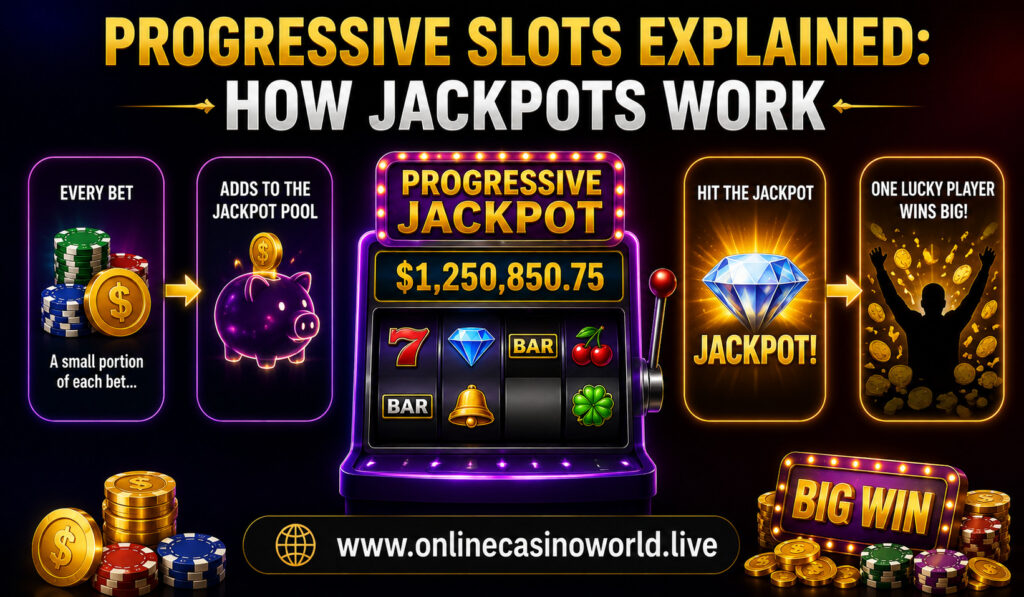
Progressive slots are a type of electronic slot game known for jackpots that can increase over time. Unlike a fixed jackpot that remains at a predetermined amount, a progressive jackpot can grow as qualifying wagers are made across a machine or network of connected games.
The idea sounds simple, but the technology and mathematics behind progressive jackpots can be confusing for beginners. Questions often arise about where the jackpot money comes from, how the amount increases, what triggers a jackpot, and whether a larger jackpot means it is more likely to be won.
This guide explains how progressive slots work, how jackpot pools are built, the difference between local and network progressives, and the important role of probability and game rules.
What Is a Progressive Slot?
A progressive slot is a slot game connected to a jackpot that can increase over time.
With a conventional fixed-paytable slot, a particular winning combination may have a predetermined payout. In a progressive slot, at least one jackpot can change as the game is played.
A small portion of qualifying wagers may contribute to the progressive jackpot pool. As more qualifying play takes place, the displayed jackpot can increase.
The jackpot eventually resets or changes after it is awarded, depending on the specific game’s rules.
It is important to understand that the jackpot amount and the probability of winning are separate concepts. A growing jackpot does not automatically mean the next spin is more likely to trigger it.
How Does a Progressive Jackpot Grow?
The progressive jackpot generally grows through contributions associated with qualifying wagers.
For example, imagine many players are participating in the same progressive game. Each qualifying play may contribute a small amount to the jackpot pool.
Over time, these contributions can cause the displayed jackpot to increase.
The exact contribution rate is determined by the game’s design and rules. Players should not assume that an identical percentage applies to every progressive slot.
The jackpot meter therefore represents a pool that can change as qualifying activity occurs.
What Happens When Someone Wins?
When the qualifying jackpot condition occurs, the jackpot is awarded according to the game’s rules.
Afterward, the progressive amount may reset to a predefined starting value or another value specified by the operator or game developer.
The exact reset procedure depends on the progressive system.
Some games may have multiple jackpot levels, meaning that winning one prize does not necessarily end the entire progressive structure.
Types of Progressive Jackpots
Progressive slots can be organized into different types.
Standalone Progressives
A standalone progressive is associated with a particular machine or a small group of machines within one location.
The jackpot grows from qualifying play on that connected group.
Because the pool is limited to a smaller number of machines, the jackpot may grow at a different rate than a large networked progressive.
Local Area Progressives
A local progressive connects multiple machines within a casino, venue, or defined area.
Qualifying wagers across the connected machines can contribute to the same jackpot pool.
This allows the jackpot to grow faster than a standalone machine when there is more qualifying activity.
Wide-Area Progressives
Wide-area progressives connect games across multiple locations.
The jackpot pool can therefore receive contributions from a much larger number of qualifying wagers.
Some of the biggest advertised progressive jackpots are associated with systems covering multiple venues.
However, the larger jackpot does not mean that a particular individual spin is guaranteed to win.
What Are Multiple Jackpot Levels?
Some progressive games contain more than one jackpot tier.
For example, a game might have:
- Mini jackpot
- Minor jackpot
- Major jackpot
- Grand jackpot
Each level may have different qualifying conditions and payout amounts.
The smaller prizes may be awarded more frequently than the largest jackpot, although the exact probabilities depend on the game’s mathematical model.
Players should consult the game’s paytable or rules for the precise conditions.
How Is a Progressive Jackpot Triggered?
The triggering mechanism depends on the specific game.
Some jackpots are triggered by a particular combination of symbols.
Others may use a special bonus feature, random trigger, or qualifying event.
A progressive jackpot may also have eligibility requirements.
For example, a player may need to be participating in a specific game or meet particular wager conditions.
Because the rules differ between games, the displayed jackpot amount should never be viewed in isolation.
Does a Bigger Jackpot Mean a Better Chance of Winning?
Not necessarily.
This is one of the most important concepts to understand about progressive slots.
The jackpot can increase without the probability of winning increasing at the same rate.
Suppose a progressive jackpot grows from ₹10 lakh to ₹20 lakh. That does not automatically mean the chance of triggering the jackpot has doubled.
The jackpot amount and the probability of winning are separate parts of the game’s mathematics.
A larger jackpot simply means that the potential prize has increased.
Understanding Random Number Generation
Modern electronic slot machines generally rely on a Random Number Generator (RNG) or related randomization technology to determine outcomes.
The RNG produces sequences of values that the game uses to determine results.
When a qualifying event occurs, the relevant game rules determine whether a progressive jackpot is awarded.
The exact technology and implementation can vary depending on the jurisdiction, game, and platform.
The important point for beginners is that previous results do not provide a reliable method for predicting the next result.
Can a Progressive Jackpot Be “Due”?
A common misconception is that a jackpot becomes due after a certain number of unsuccessful spins.
Random outcomes do not work this way.
If a progressive jackpot has not been won for a long time, that does not necessarily mean the next spin is more likely to trigger it.
Likewise, a jackpot that was recently won is not automatically less likely to appear again.
The game’s underlying probability remains governed by its mathematical design.
This is an example of the gambler’s fallacy: assuming that previous random outcomes create a requirement for a particular future outcome.
Fixed Jackpots vs Progressive Jackpots
The key difference is whether the jackpot amount can change.
A fixed jackpot has a predetermined prize value.
A progressive jackpot can increase as qualifying activity contributes to the jackpot pool.
For example, a fixed jackpot might always be ₹1 lakh, while a progressive jackpot could move from ₹1 lakh to ₹1.1 lakh and then ₹1.2 lakh as the pool grows.
The actual amounts and rules vary between games.
Progressive Slots and RTP
Return to Player (RTP) is a theoretical long-term percentage describing the amount a game is designed to return over a very large number of plays.
Progressive jackpots can be included within the mathematical structure of a game’s overall payout model.
However, the exact treatment varies by game.
A progressive game’s advertised jackpot should therefore not be interpreted as its RTP.
RTP is a long-term statistical measure, while the jackpot is a specific prize that may change over time.
What Is Volatility in Progressive Slots?
Volatility describes how a game’s outcomes are generally distributed.
A game with higher volatility may have fewer qualifying payouts but potentially larger individual outcomes.
Progressive slots can have substantial volatility because a portion of the game’s attraction may come from a large jackpot that is awarded relatively infrequently.
However, volatility varies by game, and the presence of a progressive jackpot alone does not provide enough information to determine a game’s complete payout profile.
Why Progressive Jackpots Can Become Very Large
The main reason is the size of the connected player pool.
A standalone machine receives qualifying activity from a relatively limited number of players.
A wide-area progressive can receive contributions from many machines and locations.
Even if each individual contribution is small, a large number of qualifying wagers can cause the jackpot pool to increase over time.
This creates a visible jackpot meter that can grow substantially.
Progressive Jackpot Resets
After a jackpot is awarded, the displayed value generally changes.
Depending on the game, it may reset to a predefined starting amount or another value determined by the progressive system.
The jackpot can then begin growing again through subsequent qualifying play.
This creates a repeating cycle:
Starting value → Contributions → Growing jackpot → Winning event → Reset → New growth
The exact process depends on the specific progressive game.
Can Everyone Win a Progressive Jackpot?
Eligibility depends on the game’s rules.
Some progressive jackpots may require a player to be playing a particular game or meeting a qualifying wager condition.
Others may use different eligibility requirements.
The fact that a jackpot is displayed does not mean that every person observing the machine is automatically eligible to win it.
Reading the game’s rules is therefore important.
Why Progressive Slots Look Different From Traditional Slots
Progressive games often display a large jackpot meter prominently.
The changing amount is designed to show the current value of the progressive pool.
Modern progressive slots may also include detailed graphics, animations, bonus rounds, and multiple jackpot levels.
However, the visual presentation does not determine the probability of winning.
The underlying mathematical model and rules remain the important factors.
Common Misunderstandings About Progressive Slots
One misconception is that the largest displayed jackpot is always the easiest to win.
That is not necessarily true.
Another is that a machine that has not paid a jackpot recently must be close to awarding one.
There is no general rule supporting this assumption.
Some people also assume that increasing the wager automatically guarantees eligibility for every jackpot. This depends entirely on the game’s rules.
Finally, a large progressive jackpot should not be confused with guaranteed profit. The jackpot is simply one possible outcome within a broader mathematical system.
Responsible Gambling Considerations
Progressive jackpots can be particularly attention-grabbing because the displayed amount continuously changes.
The possibility of a large prize can make it tempting to spend more than originally planned.
However, winning a progressive jackpot is not guaranteed, and gambling outcomes can result in financial losses.
Anyone who chooses to participate should understand the rules, follow applicable laws, set a firm spending limit, and avoid using money needed for essential expenses.
It is also important not to chase losses or increase spending simply because a jackpot has grown.
If gambling becomes difficult to control, seeking support from a qualified professional or an appropriate gambling-support organization may be helpful.
Final Thoughts
Progressive slots combine traditional slot-machine mechanics with a changing jackpot pool.
The jackpot can grow because qualifying wagers contribute to the progressive system. Depending on the game, the jackpot may operate on a standalone machine, across a local group of machines, or through a much larger network.
The most important thing to remember is that a larger jackpot does not automatically mean a higher chance of winning. Probability is determined by the game’s mathematical design, while the jackpot amount represents the potential prize.
Understanding concepts such as RNGs, RTP, volatility, jackpot tiers, contribution systems, and eligibility rules can help beginners understand progressive slots more clearly.
Ultimately, progressive slots remain games of chance. No timing pattern, previous result, or betting system can guarantee that a particular spin will trigger the jackpot.