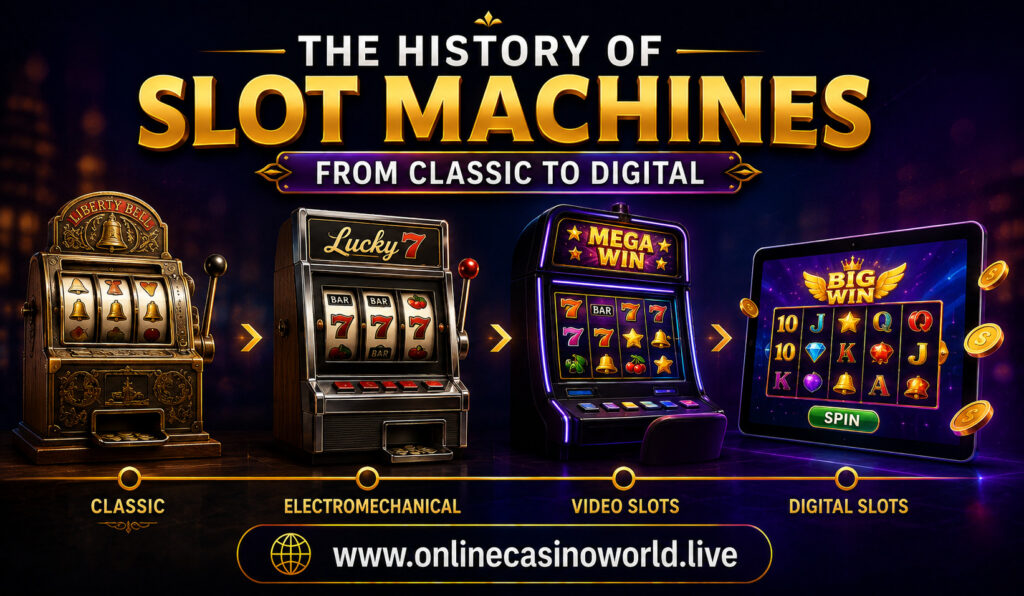
The History of Slot Machines: From Classic to Digital
Slot machines have come a long way from the simple mechanical gambling machines found in old-fashioned bars and casinos. Today, players can encounter digital slot games with immersive graphics, animated themes, bonus rounds, progressive jackpots, and features designed for smartphones and computers. Yet, despite all these changes, the basic idea remains remarkably familiar: spin the reels, match symbols, and see what combination appears.
The history of slot machines is a fascinating story of mechanical innovation, changing casino culture, electronics, software, and the growth of online gaming. Understanding how slot machines developed from basic mechanical devices into sophisticated digital games also explains why they remain one of the most recognizable forms of casino entertainment.
The Birth of the First Slot Machine
The origins of slot machines can be traced back to the late 19th century. One of the earliest machines was created by Charles Fey, a San Francisco-based mechanic, in the 1890s. His famous Liberty Bell machine used three reels and a small number of symbols.
Players inserted a coin and pulled a lever to spin the reels. If certain symbols lined up, the machine provided a winning combination. The Liberty Bell became an important milestone because it introduced many of the characteristics that would later define the traditional slot machine.
The machine included symbols such as bells, horseshoes, and playing-card suits. The Liberty Bell symbol eventually became closely associated with slot machines, and the term “Liberty Bell” is still used when discussing the early history of the industry.
How Early Mechanical Slots Worked
The earliest slot machines were completely mechanical. There were no computer screens, electronic displays, or software-generated results. When a player pulled the lever, a mechanical system caused the reels to spin.
Inside the machine were gears, springs, levers, and other mechanical components. The arrangement of symbols on the reels determined which combinations were possible.
Because these machines were mechanical, manufacturers had to work within physical limitations. The number of symbols and winning combinations was relatively small compared with modern digital slots.
The lever also became an iconic part of the traditional slot machine. It was not simply a practical control; it became part of the experience. Pulling the lever created a physical connection between the player and the machine.
The Expansion of Slot Machines
During the early 20th century, slot machines became increasingly popular in entertainment venues. However, gambling laws in different regions often restricted the use of machines that paid cash prizes.
Manufacturers responded with creative alternatives. Some machines rewarded players with products such as chewing gum instead of money. Different fruit symbols were used to represent various flavors, helping establish the familiar cherries, lemons, oranges, and plums associated with traditional slots.
These fruit symbols eventually became one of the most recognizable visual features of slot machines.
As regulations changed and casino gambling expanded, slot machines gradually became a major part of the gaming industry. Their relatively simple rules made them accessible to people who did not necessarily understand complicated table games.
The Move From Mechanical to Electromechanical Slots
A major transformation occurred in the middle of the 20th century when manufacturers began combining mechanical reels with electrical components.
One important development was Bally’s Money Honey, introduced in the 1960s. It used electromechanical technology and featured automatic payouts, allowing it to handle larger winnings than many earlier machines.
This period marked the beginning of a gradual transition away from purely mechanical slot machines.
The lever remained part of the design, but its role increasingly became more symbolic. Instead of directly controlling every mechanical process, it could activate an electrical system that controlled the reels.
Electromechanical technology also allowed manufacturers to introduce more complicated features and larger payout possibilities.
The Rise of Video Slot Machines
The next major breakthrough came with the introduction of video technology.
Instead of relying entirely on physical reels, video slot machines could display the game on a screen. This opened the door to much greater flexibility in game design.
Manufacturers were no longer limited by the physical size of mechanical reels. A digital display could show multiple paylines, additional symbols, animated effects, and bonus features.
Video slots also made it possible to create games around different themes. Developers could use popular entertainment, mythology, adventure, fantasy, sports, and other concepts to create more visually engaging experiences.
This transformation helped establish the modern slot machine as more than a basic three-reel game.
Random Number Generators Changed Everything
One of the most important technologies behind modern digital slots is the random number generator, commonly known as an RNG.
An RNG is designed to produce sequences of numbers that determine game outcomes. In a digital slot, the outcome is not created by physically stopping spinning reels in the traditional mechanical sense. Instead, software uses the RNG system to determine which symbols or combinations appear.
This technology allows digital slot games to offer enormous flexibility. Developers can create different reel layouts, paylines, winning combinations, bonus features, and game mechanics without needing to build everything mechanically.
The introduction of RNG-based systems was therefore a crucial step in the evolution from classic machines to modern digital slots.
The Internet Brings Slots Online
The growth of the internet during the 1990s created another major turning point.
Online casinos began offering digital versions of popular casino games, including slot machines. Players no longer needed to visit a physical casino to access a slot-style game.
Online slots could reproduce the basic experience of traditional machines while adding features that were difficult or impossible to implement with physical equipment.
Digital games could include several paylines, animated interfaces, bonus rounds, interactive features, and different betting options. Because the games were software-based, developers could also introduce new themes and mechanics more frequently.
The online casino industry helped make slot games accessible to a much wider audience around the world, although availability and legality have always depended on local regulations.
The Smartphone Era
The development of smartphones created another significant chapter in slot machine history.
Mobile-friendly slot games allowed users to access digital casino entertainment through phones and tablets. Developers began designing games specifically for smaller touchscreens rather than simply shrinking desktop versions.
Touch controls replaced traditional physical levers. Players could tap a button to spin the reels, choose betting options, activate features, and navigate game menus.
Mobile technology also encouraged developers to focus heavily on graphics, responsive design, short sessions, and easy-to-use interfaces.
Today, mobile compatibility is an important consideration for many digital gaming platforms.
Modern Slots Are More Complex Than Ever
Modern slot games can look very different from the classic machines of the early 20th century. Some feature cinematic animations, detailed characters, sound effects, interactive bonus rounds, cascading symbols, expanding wilds, multipliers, and progressive jackpots.
Megaways-style mechanics and other variable-payline systems have also demonstrated how software can completely change the traditional reel structure.
At the same time, classic three-reel games remain popular. Many modern developers create games that combine traditional symbols and simple layouts with digital technology.
This shows that the history of slot machines is not simply a story of old games disappearing. Instead, classic ideas have been continuously adapted to new technologies.
Progressive Jackpots and Networked Games
Digital technology also made it possible to connect games across multiple machines or platforms.
Progressive jackpot slots can increase a potential jackpot as qualifying bets contribute to the prize pool. In some systems, linked games can contribute toward a larger jackpot than an individual machine could realistically offer on its own.
Network connectivity has therefore become another important part of the evolution of modern slot gaming.
These systems demonstrate how digital technology changed not only the appearance of slots but also the way games could be connected and operated.
From Pulling a Lever to Tapping a Screen
The physical experience of playing a slot machine has changed dramatically.
Early players pulled a heavy lever and listened to mechanical reels spinning inside the cabinet. Modern players may simply tap a digital button on a smartphone.
Despite this difference, the fundamental concept remains similar. Symbols are displayed, a game outcome is generated, and the player sees whether the selected combination produces a prize.
The biggest difference is the technology behind the experience.
Mechanical components have largely given way to electronics, software, high-resolution displays, and network connectivity.
The Future of Slot Machines
The evolution of slot machines is unlikely to stop with smartphones and online platforms. Emerging technologies could continue to change how digital casino games are designed and experienced.
Improved graphics, virtual reality, augmented reality, artificial intelligence, and more sophisticated interactive features could create increasingly immersive gaming environments. At the same time, regulatory requirements and responsible gaming practices are likely to remain important considerations for the industry.
The future may look very different from the Liberty Bell, but the basic appeal of simple, easy-to-understand gameplay is likely to remain.
Conclusion
The history of slot machines is a journey from mechanical engineering to sophisticated digital software. The first machines relied on gears, reels, and levers, while modern versions use electronic systems, random number generators, advanced graphics, and internet connectivity.
Each technological development expanded what slot machines could offer. Mechanical slots established the basic format, electromechanical machines introduced greater automation, video slots expanded game design, online casinos made digital slots widely accessible, and smartphones brought them to mobile screens.
What began as a simple mechanical entertainment device has therefore evolved into a highly flexible digital gaming format. While the look, technology, and features continue to change, the familiar idea of spinning reels and waiting for the result remains at the heart of the slot machine experience.