
How Baccarat Works: A Simple Beginner’s Guide
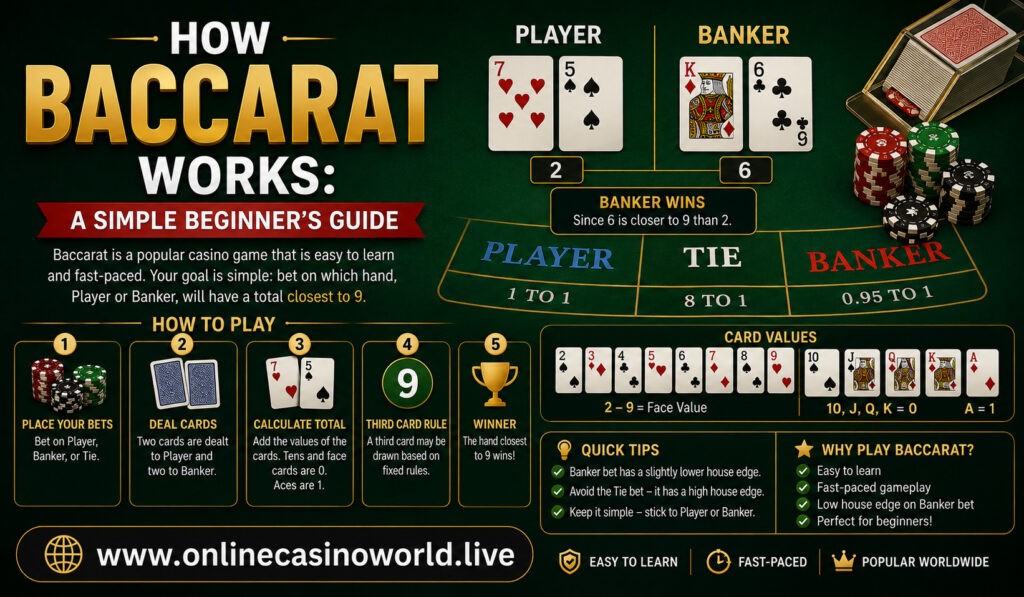
Baccarat is a classic card game that is often associated with casinos, but its basic rules are surprisingly simple. Unlike blackjack, players do not usually decide whether to take another card. Instead, cards are dealt according to predetermined rules, and the goal is to determine which hand finishes closest to a total of 9.
For beginners, baccarat can seem confusing because the scoring system is different from many familiar card games. However, once you understand card values, the drawing rules, and the difference between the Player and Banker hands, the game becomes much easier to follow.
This beginner’s guide explains how baccarat works, how points are calculated, how a round is completed, and the important differences between common baccarat bets.
What Is Baccarat?
Baccarat is a card game involving two competing hands traditionally called the Player and the Banker.
The objective is to predict which hand will have a final value closest to 9, or whether the two hands will have the same value.
Despite the names, the Player and Banker labels do not necessarily mean that an individual participant is physically playing the cards. They are simply the names given to the two hands in the standard game.
A typical round involves two initial cards for each hand, followed by a possible third card according to fixed rules.
Unlike blackjack, players generally do not decide whether another card should be dealt.
Understanding Baccarat Card Values
The scoring system is one of the most important baccarat rules to learn.
Cards from 2 through 9 are worth their face value.
For example:
- 2 = 2 points
- 5 = 5 points
- 8 = 8 points
However, 10s and face cards have a value of 0.
That means:
- 10 = 0
- Jack = 0
- Queen = 0
- King = 0
An Ace is worth 1 point.
The total is calculated using the last digit of the combined value.
For example, if a hand contains a 7 and a 5, the total is 12. In baccarat, the hand value is therefore 2, not 12.
This rule is known as reducing the total to its final digit.
How the Baccarat Score Is Calculated
Suppose the cards are:
7 + 2 = 9
The hand has a value of 9.
Now consider:
8 + 7 = 15
Only the final digit counts, so the baccarat value is 5.
Another example:
9 + 6 = 15 → 5
This scoring method means that the highest possible baccarat hand value is 9.
There is no traditional score of 10, 11, 12, and so on.
The Goal of Baccarat
The goal is to identify which hand will finish closest to 9.
There are usually three basic outcomes:
- The Player hand wins.
- The Banker hand wins.
- The two hands tie.
The terms can be slightly misleading for newcomers. The Player and Banker are simply the names of the two hands.
Once the cards have been dealt and any required third card has been added, the final values are compared.
The hand closest to 9 is the winner.
How a Baccarat Round Begins
A standard round begins with two cards dealt to the Player hand and two cards dealt to the Banker hand.
The values of those cards are calculated using baccarat’s scoring system.
If the initial cards produce a qualifying natural total, the round may end immediately.
If not, the rules determine whether a third card is required.
This is where baccarat differs significantly from blackjack.
In blackjack, the player typically decides whether to hit or stand. In baccarat, the third-card rules are predetermined.
What Is a Natural in Baccarat?
A natural generally refers to an initial two-card total of 8 or 9.
If either the Player or Banker hand has a natural, the third-card procedure may not be necessary.
For example:
Player: 4 + 5 = 9
The Player has a natural 9.
Another example:
Banker: 6 + 2 = 8
The Banker has a natural 8.
The exact treatment of naturals depends on the baccarat variant and table rules.
How the Third Card Works
If neither side has a qualifying natural, a third card may be dealt according to baccarat’s fixed rules.
The Player hand follows one set of rules for drawing a third card.
The Banker’s third-card decision is more complicated because it can depend on the Banker’s current total and, in some cases, the value of the Player’s third card.
The important point for beginners is that these decisions are generally determined by the rules rather than personal choice.
You do not normally tell the Banker when to draw or stand.
Player Hand Drawing Rules
In standard baccarat, the Player hand generally draws a third card when its initial total is between 0 and 5.
A Player total of 6 or 7 generally stands.
A natural 8 or 9 ends the drawing process.
These rules can vary in specialized baccarat versions, so the specific table rules should always be checked.
Banker Hand Drawing Rules
Banker drawing rules are more detailed.
The Banker’s action depends on its current total and, when relevant, the value of the Player’s third card.
For example, the Banker generally stands on totals of 7 and draws on lower totals, but certain situations depend on the Player’s third card.
This complexity is one reason baccarat tables often display a rules guide.
Players do not normally need to make these decisions themselves because the dealing procedure follows the predetermined rules.
Player, Banker and Tie Outcomes
Once all required cards have been dealt, the two final totals are compared.
If the Player has a higher total, the Player hand wins.
If the Banker has a higher total, the Banker hand wins.
If both have the same total, the result is a tie.
For example:
Player = 7
Banker = 5
The Player hand has the higher value.
Another example:
Player = 6
Banker = 6
The result is a tie.
Understanding Baccarat Bets
The most common baccarat wagers correspond to the three possible outcomes:
Player
This predicts that the Player hand will finish with the higher value.
Banker
This predicts that the Banker hand will finish with the higher value.
Tie
This predicts that both hands will have the same final value.
The payout and house advantage can differ between these options.
In particular, Banker bets often involve a commission in traditional baccarat because the Banker hand has a mathematical advantage in winning slightly more frequently than the Player hand.
Some modern baccarat tables use alternative commission structures or special rules, so beginners should read the posted conditions carefully.
Why the Banker Hand Has a Mathematical Advantage
The Banker hand has a small statistical advantage because of the order and structure of the drawing rules.
This is why traditional baccarat tables commonly apply a commission to winning Banker bets.
The exact house edge depends on the rules and commission structure.
This is an important distinction between baccarat and games where all basic outcomes have identical probabilities.
Understanding the mathematics can help beginners distinguish between probability and perception.
Is Baccarat a Game of Skill?
Baccarat generally involves much less player decision-making than blackjack.
Once a wager is selected, the cards are dealt according to fixed procedures.
Players do not normally decide when to hit, stand, or draw.
As a result, baccarat is primarily a game of chance rather than a game where a player controls the sequence of decisions.
Different betting systems may be discussed around baccarat, but no betting pattern can change the underlying probability of the cards.
Baccarat vs Blackjack
Baccarat and blackjack are both card games, but their mechanics are quite different.
In blackjack, players make decisions during their hands.
In baccarat, the drawing rules determine what happens after the initial cards.
Blackjack aims to get as close to 21 as possible without going over.
Baccarat aims for a final value closest to 9.
Blackjack also uses card values differently. Face cards generally count as 10, while baccarat assigns them a value of 0.
These differences make baccarat considerably easier to follow once its unique scoring system is understood.
Baccarat vs Roulette
Baccarat and roulette also differ in how their outcomes are produced.
Roulette uses a spinning wheel and ball. Players predict where or in which category the ball will land.
Baccarat uses cards and compares two hands.
Roulette outcomes are based on the wheel’s numbered pockets, while baccarat outcomes depend on the cards dealt under predetermined drawing rules.
Both are games of chance, but their mechanics and probability structures are different.
Common Baccarat Misconceptions
One common misconception is that a particular hand is “due” after a long sequence of results.
Previous rounds do not guarantee what will happen next.
Another misconception is that betting systems can eliminate the house edge. They cannot.
The fact that baccarat has relatively simple rules does not mean individual outcomes can be predicted with certainty.
A long winning or losing sequence can occur simply because random events can produce unusual patterns.
Baccarat Variations
There are several baccarat variations.
The most widely recognized is Punto Banco, which uses predetermined drawing rules.
Other versions can modify the rules, number of decks, commission structure, or available bets.
Because these differences can affect probabilities and payouts, beginners should always check the rules of the particular version they are learning.
Responsible Gambling and Baccarat
Baccarat involves financial risk when played for money.
Understanding the rules does not remove that risk, and there is no guaranteed method of turning a gambling game into a reliable source of income.
Anyone who chooses to participate should follow applicable laws, establish a strict budget, avoid chasing losses, and never gamble with money needed for essential expenses.
If gambling becomes difficult to control, seeking help from an appropriate professional or gambling-support organization can be an important step.
Final Thoughts
Baccarat may look complicated at first, but its basic objective is straightforward: determine whether the Player hand, Banker hand, or a tie produces the outcome, with the winning hand being the one closest to 9.
The key concepts for beginners are baccarat card values, the single-digit scoring system, natural 8s and 9s, and the predetermined third-card rules.
Unlike blackjack, players generally do not decide whether another card is drawn. The game follows established procedures that determine how the hands develop.
Understanding these rules provides a clear foundation for learning about baccarat without relying on myths or supposed prediction systems. Most importantly, baccarat remains a game of chance, and individual results cannot be guaranteed.