Blackjack vs Roulette: Key Differences Explained
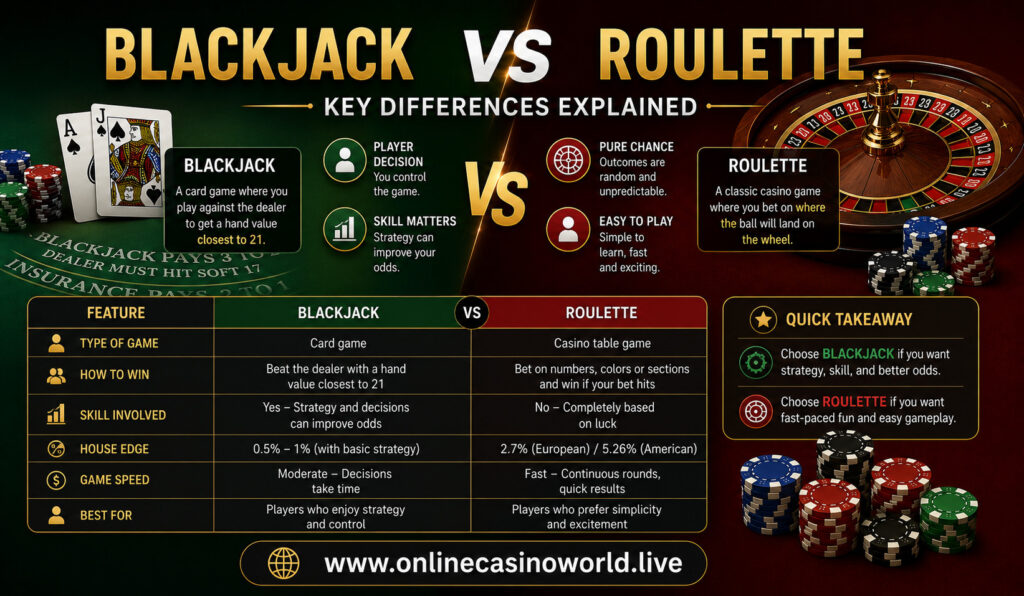
Blackjack and roulette are two of the most recognizable casino games, but they work in very different ways. Blackjack is a card game where players make decisions during a hand, while roulette is based on the outcome of a spinning wheel and ball.
For someone unfamiliar with casino games, the two may seem similar because both involve wagers and predetermined rules. However, their gameplay, probability, decision-making, and house advantage are structured differently.
Understanding these differences can help beginners learn how each game works without confusing their rules or expectations.
What Is Blackjack?
Blackjack is a card game played against a dealer. The primary objective is to have a hand value closer to 21 than the dealer without exceeding 21.
Number cards retain their printed values, while Jacks, Queens, and Kings generally count as 10. An Ace can count as either 1 or 11, depending on which value is more useful without causing the hand to exceed 21.
Players receive cards and can usually choose actions such as hitting, standing, doubling down, or splitting, depending on the table’s rules.
The dealer follows predetermined rules for playing their hand.
Because players make decisions during a hand, blackjack has a strategic component that roulette does not have in the same way.
What Is Roulette?
Roulette is a wheel-based game. A dealer spins a numbered wheel and releases a small ball in the opposite direction.
The ball eventually settles into one of the wheel’s pockets.
Players make predictions before the spin. These can involve a specific number, a color, an odd or even number, or a larger group of numbers.
European roulette typically contains 37 pockets, numbered 0 through 36. American roulette has 38 pockets because it includes both 0 and 00.
The outcome of a spin is random, and previous spins do not determine the next result.
Blackjack vs Roulette: How Gameplay Differs
The biggest difference between blackjack and roulette is the way each game produces its outcome.
In blackjack, the result depends on cards drawn from the deck and the decisions made during the hand. Players can choose between available actions according to the rules.
In roulette, players make their predictions before the wheel is spun. Once the ball is released, there is generally no decision that can change the result.
This makes blackjack more interactive from a decision-making perspective, while roulette has a simpler prediction-based structure.
Difference in Player Decisions
Blackjack gives players several choices.
Depending on the rules, a player may:
- Hit and take another card
- Stand with the current hand
- Double down
- Split certain hands
- Sometimes surrender
The correct action can depend on the player’s cards, the dealer’s visible card, and the specific rules of the table.
Roulette generally involves fewer decisions after a bet is placed. Players select the type of outcome they are predicting, and the wheel determines the result.
This difference makes blackjack more decision-oriented than roulette.
Blackjack vs Roulette: Understanding Probability
Probability works differently in the two games.
In roulette, the wheel has a fixed number of possible pockets. A European wheel has 37 pockets, while an American wheel has 38.
For example, betting on a single number in European roulette means selecting one pocket out of 37. In American roulette, the same type of bet covers one pocket out of 38.
Blackjack is more complicated because probabilities depend on the composition of the deck, the number of decks being used, cards already dealt, and the rules of the specific game.
Players’ decisions can also influence the expected outcome of a hand.
House Edge Comparison
The house edge is the mathematical advantage built into a casino game over a large number of plays.
For standard roulette:
European Roulette: approximately 2.70% house edge
American Roulette: approximately 5.26% house edge
The difference exists largely because American Roulette has an additional 00 pocket.
Blackjack does not have one universal house-edge figure because it depends heavily on the exact rules and player decisions. Factors such as blackjack payouts, dealer rules, number of decks, doubling restrictions, and splitting rules can affect the mathematics.
This is why simply comparing one headline percentage for blackjack and roulette can be misleading.
Does Skill Matter More in Blackjack?
Blackjack provides more opportunities for player decision-making than roulette.
Players can choose how to respond to their current hand. Mathematical strategy can help reduce the house advantage under favorable rules and when decisions are made correctly.
However, blackjack is still not a guaranteed way to make money. The cards are random, and individual hands can produce unpredictable results.
Roulette does not offer the same type of decision-making after the wager is placed. Choosing red, black, a particular number, or another category does not alter the physical probability of the wheel.
Therefore, blackjack has a stronger decision-making component, while roulette is more directly based on the random outcome of the wheel.
Types of Bets
The betting structures are also very different.
Roulette offers numerous bet types. Players can select individual numbers or larger categories such as:
- Red or black
- Odd or even
- High or low numbers
- Dozens
- Columns
- Groups of numbers
Blackjack does not use this type of numbered betting layout. The primary wager is placed on the player’s hand, while optional side bets may exist depending on the table.
Side bets can have completely different mathematical characteristics from the main blackjack game, so they should be evaluated separately.
Blackjack vs Roulette: Speed of Play
The pace can vary significantly depending on the table and the number of players.
Roulette rounds can be relatively quick because players place bets, the wheel is spun, and the result is determined.
Blackjack can take longer because each player makes decisions individually before the dealer completes their hand.
Online versions of both games can operate at different speeds depending on the platform and format.
The pace should not be confused with probability. A faster game simply creates more rounds within a given period; it does not improve the mathematical chances of winning.
Which Game Is Easier to Learn?
For basic rules, roulette is generally straightforward.
A beginner only needs to understand the wheel, betting areas, winning numbers, colors, and payouts to understand the basic mechanics.
Blackjack requires learning card values and several player actions.
The core objective is still simple, but understanding the different decisions can take more time.
Therefore, roulette may be easier to understand initially, while blackjack requires more knowledge of card values and decision rules.
European Roulette vs Blackjack
When comparing blackjack with European roulette specifically, the key difference remains the source of randomness.
European roulette uses a wheel containing 37 pockets.
Blackjack uses cards, and the probability of receiving particular cards changes as cards are dealt from the deck.
European roulette also has a clearly defined standard house edge for many common bets, while blackjack’s mathematical advantage depends more heavily on its specific rules and how the player plays.
American Roulette vs Blackjack
American roulette has both 0 and 00, giving it a higher standard house edge than European roulette.
Blackjack’s house edge can vary considerably depending on table conditions.
As a result, the comparison between American roulette and blackjack is not simply about which game has a universally better mathematical outcome. The exact blackjack rules and player decisions matter significantly.
Common Misconceptions
One common misconception is that previous roulette results can predict future spins.
They cannot. If the wheel has landed on red several times, black is not automatically due.
Another misconception is that blackjack allows players to control the cards.
Players can make decisions, but they cannot control which cards are dealt.
Similarly, a strategy does not guarantee a winning session. Probability describes patterns over many trials, not certainty in individual rounds.
Which Game Is More Interactive?
If interaction means making decisions during a round, blackjack generally offers more opportunities.
A player can respond to their hand and the dealer’s visible card.
Roulette is more prediction-oriented. Players select a betting category and then observe the wheel’s outcome.
Neither structure makes one game inherently risk-free. Both can involve financial losses when played for money.
Responsible Gambling Considerations
Both blackjack and roulette involve gambling risk.
Players should understand that neither game provides guaranteed income. Short-term results can differ substantially from long-term mathematical expectations.
Anyone who chooses to gamble should set a budget beforehand, avoid chasing losses, and never use money needed for essential expenses.
It is also important to follow the laws applicable to gambling in the relevant location.
Final Thoughts
Blackjack and roulette may share a casino setting, but their mechanics are fundamentally different.
Blackjack is a card game involving player decisions, while roulette is a wheel-based game where the result comes from the ball’s final position.
Roulette is generally easier to learn at a basic level, while blackjack involves more decisions and a more complicated probability structure. European roulette has a lower standard house edge than American roulette, while blackjack’s mathematical characteristics depend strongly on the rules and how the game is played.
The most important takeaway for beginners is to understand that both are games of chance. Learning the rules and mathematics can provide a clearer understanding of the games, but no system can guarantee a profit.